
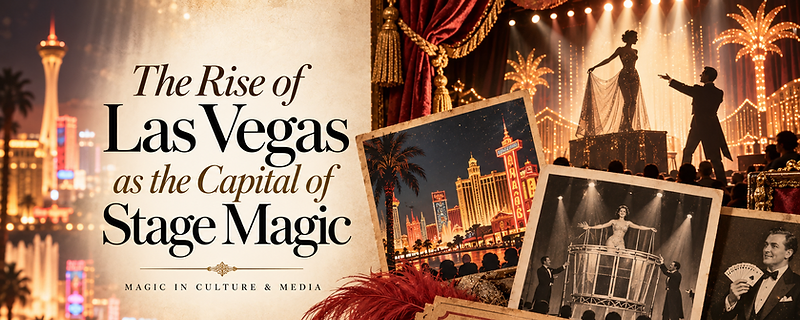
The Rise of Las Vegas as the Capital of Stage Magic
Las Vegas did not invent stage magic, and it was not always the center of the art. Its importance grew gradually as casino showrooms, resort economics, tourism, television, and purpose-built theaters created something earlier touring illusionists could only have imagined: a city where a magician could stop traveling, install an enormous production permanently, and perform for a new audience night after night. From Gloria Dea and the early Strip to Siegfried & Roy, Lance Burton, David Copperfield, Penn & Teller, Mac King, and Criss Angel, Las Vegas changed not only where magic was performed, but what a professional magician's career could look like.
By The Upchurch Collection of Magic
September 27, 2026

For most of the great history of stage magic, success meant movement. Kellar,, Thurston,, Houdini,, Blackstone,, Dante,, and the other major touring performers carried their shows from city to city because eventually everyone who wanted to see the magician in one place had bought a ticket. The company packed the apparatus, scenery, costumes, animals, and trunks and moved on. Las Vegas eventually reversed that relationship. Instead of the magician traveling continually to find a new audience, the audience traveled continually to the magician. That simple change transformed the economics of stage magic and helped turn a desert resort city into the most concentrated center of professional magic performance in the world.
Las Vegas offered something unusually well suited to illusion. The casinos needed entertainment that would attract visitors, keep them on property, and distinguish one resort from another. The city already supported large showrooms, elaborate production values, dancers, musicians, comedians, singers, specialty acts, and technical crews capable of mounting complicated live entertainment. Most importantly, the audience constantly replenished itself. Millions of tourists could sustain a production in one building for years in a way that would have been almost impossible in an ordinary American city. Eventually, that environment allowed magicians to replace the freight train and touring truck with something very different: a permanent theater engineered around the illusions themselves.
Before Las Vegas Became a Magic City
Magic appeared on the Las Vegas Strip almost from the beginning. In 1941, Gloria Dea, only eighteen years old, performed magic at the El Rancho Vegas, generally recognized as the first casino resort on what would become the Strip. UNLV recognizes her as the first magician to perform there. Dea had learned magic from her father and was already working professionally as a young performer before later pursuing film and other entertainment work. Her place in the story is especially fitting because the first known Strip magician was not one of the giant male illusion stars who would later become synonymous with Las Vegas, but a young woman performing during the city's earliest resort era. (Source: UNLV College of Fine Arts — Gloria Dea.)
For decades afterward, however, magic was generally only one component of a much larger Las Vegas entertainment ecosystem. Magicians appeared as specialty acts inside revues, casino productions, lounges, and variety shows. That system was enormously important because it created a place where a magician could work steadily and refine a short act in front of demanding audiences. A performer might have only several minutes inside a much larger production, which encouraged effects that were visual, immediate, and strong enough to compete with dancers, comedians, singers, and elaborate scenery. Las Vegas was becoming a proving ground long before it became a city of dedicated magic theaters.
That distinction matters. The city's eventual dominance did not begin when casinos suddenly decided that magic was important. It grew from decades of specialty entertainment in which magicians learned how to function inside the peculiar machinery of Las Vegas: multiple shows, tourists from everywhere, fast production schedules, sophisticated technical support, and an audience surrounded by competing attractions.
Siegfried & Roy Make Magic Big Enough for Las Vegas
No performers did more to establish the image of Las Vegas magic as overwhelming spectacle than Siegfried & Roy.. Siegfried Fischbacher and Roy Horn arrived in Las Vegas in 1967 as a specialty act in the Folies Bergère at the Tropicana. Their combination of illusion, theatrical staging, and exotic animals distinguished them from conventional manipulative acts, and over the following decades they appeared in increasingly prominent productions before becoming headliners in their own right. By 1990 they opened their celebrated show at the new Mirage, where they remained until 2003. UNLV's archival collection documents the Mirage run and its central place in the duo's Las Vegas career. (Source: UNLV Special Collections — Siegfried and Roy Memorabilia Collection.)
The Mirage production represented something larger than a successful magic show. Siegfried & Roy became part of the identity of the resort itself. Their white tigers and lions, elaborate illusions, enormous stage pictures, costumes, music, lighting, and theatrical machinery created an attraction that was difficult to separate from the broader fantasy of Las Vegas. The magician was no longer simply occupying a casino showroom. The show could help define the casino.
This was an important change from the Golden Age touring model. Thurston might arrive in town with an enormous show, but everything ultimately had to be dismantled and transported somewhere else. At a permanent Las Vegas production, machinery could be engineered into the building, backstage spaces could be designed for particular effects, animals could be housed nearby, and large scenic elements could remain in place. An illusion did not have to fit inside a touring crate. The theater itself could become part of the apparatus.
Siegfried & Roy demonstrated the commercial potential of that model on a scale impossible to ignore. Their Mirage residency lasted thirteen years before Roy Horn was severely injured by a tiger during a performance in 2003, abruptly ending the regular show. By then, however, the larger transformation was already complete. A magician—or in their case, an illusion duo—could stand beside singers, comedians, and production spectacles as one of the defining headliners of Las Vegas.
Lance Burton and the Purpose-Built Magic Theater
Lance Burton represented another stage in that evolution. After arriving in Las Vegas in 1982 as a featured performer in the Tropicana's Folies Bergère, Burton spent years developing his career within the city's entertainment system. He eventually moved from specialty act to headliner at the Hacienda in 1991. In 1996, when the Monte Carlo opened, Burton began a long residency in a theater built and named specifically for him. UNLV records that the Lance Burton Theater was the first Las Vegas theater built and named for an individual entertainer, while his original contract ran for an extraordinary thirteen years. He remained at the Monte Carlo until 2010 and performed thousands of shows there. (Source: UNLV College of Fine Arts — Lance Burton.)
The significance went beyond Burton's personal success. A purpose-built theater represented an enormous commitment by a resort to the idea that one magician could provide stable, long-term entertainment. The magician was no longer renting or adapting a room. The room itself could be planned around the magician.
Burton's show was also important because it preserved a more traditional image of stage magic at a time when entertainment was rapidly modernizing. His dove work, formal appearance, large illusions, graceful staging, and family-friendly presentation maintained a recognizable connection to classical manipulation and grand illusion. He demonstrated that Las Vegas did not require every magician to reinvent the art as rock concert or counterculture. Traditional stage magic, presented exceptionally well, could sustain a major residency for years.
That long-term stability changed the professional possibilities available to magicians. A touring entertainer could spend much of the year traveling, loading equipment, checking into hotels, and adjusting to different stages. A successful Las Vegas headliner could instead perform in a theater whose dimensions, lighting positions, backstage systems, and audience sightlines remained consistent. The result could be technically more precise and dramatically more ambitious.
Las Vegas Discovers That Magic Does Not Need One Style
Penn & Teller represented almost the opposite theatrical personality. Their work challenged traditional magical presentation through comedy, skepticism, apparent exposure, intellectual games, and deliberate violations of the solemn traditions surrounding magic. They made their Las Vegas debut at Bally's in 1993 and began their long-running Rio residency in 2001. By 2016, their official history identified them as the longest-running headlining act in Las Vegas history. Their success demonstrated that Las Vegas could sustain not only grand illusion but a highly distinctive, personality-driven form of magic that frequently questioned the conventions of the art while still depending upon extraordinary technical skill. (Source: Penn & Teller — Historic Timeline.)
At the other end of the scale, Mac King proved that a hugely successful Las Vegas magic show did not require enormous scenery, dangerous animals, or multimillion-dollar illusion equipment. His comedy magic show began at Harrah's in 2000 and became one of the city's longest-running one-man productions. Rope, cards, comedy, audience participation, and deliberately modest props could survive beside the biggest spectacles on the Strip because the real attraction was the performer. That diversity was crucial to Las Vegas becoming a genuine magic ecosystem rather than simply a location for one particular kind of illusion.
There were close-up performers, comedy magicians, mentalists, hypnotists, afternoon shows, family productions, adult-oriented magic, large-scale illusion, and experimental hybrids. Some performers became famous because of Las Vegas. Others arrived with fame already established through television or touring. The city could accommodate both.
Criss Angel and the Magic Show as a Concert Spectacle
The rise of Criss Angel demonstrated another shift. Angel had already become an international television personality through Mindfreak when his Las Vegas career moved into large-scale resident production. His BeLIEve show opened at the Luxor in partnership with Cirque du Soleil, eventually evolving away from its original form and toward a more direct representation of Angel's darker, rock-influenced magical identity. Later versions of MINDFREAK increasingly merged stage illusion with the visual language of a concert: massive video surfaces, pyrotechnics, loud music, lighting effects, projection, and fast-paced theatrical technology. His current Planet Hollywood production grew directly out of that approach.
Whether an audience prefers that style is a matter of taste, but historically it represents an important development. The Las Vegas illusion show had absorbed the production values of arena concerts, theme parks, digital media, and contemporary live spectacle. Kellar's painted devils and Thurston's lithographic universe belonged to an age of print and theatrical machinery. Angel's environment belongs to LED walls, amplified music, video, fire, digital imagery, and immersive production.
The goal is surprisingly similar. Both generations wanted to make the magician appear larger than ordinary life.
The technology available to do it had changed.
Why Magic and Las Vegas Fit Each Other
The connection between Las Vegas and magic eventually became so natural that it can seem inevitable, but the two grew together because they share several characteristics. Both depend upon controlled environments. Both deal in fantasy. Both understand anticipation, spectacle, architecture, lighting, and the deliberate manipulation of attention. A casino resort is itself an engineered environment designed to separate visitors temporarily from ordinary routines. Magic asks for a similar suspension of normal expectations.
The business model also solved one of magic's oldest problems. A touring magician eventually exhausts a local audience. Las Vegas continuously replaces the audience. The visitor arriving tonight probably did not see the show yesterday. That makes it possible to perform a tightly engineered production thousands of times without continually relocating it. The performer gains technical consistency, while the resort gains a recognizable attraction that can be advertised internationally.
Permanent residency also allows an illusionist to invest in effects that make little sense on tour. A mechanism can be integrated into a stage. Heavy equipment does not need to be transported every night. Lighting cues can be perfected. Assistants and technicians can execute the same complicated sequences repeatedly in the same environment. The production becomes almost architectural.
That has consequences for the art itself. Some illusions exist in the form they do because Las Vegas made them economically possible.
From Destination for Magicians to Magic Destination
This concentration also created a professional community. Magicians could watch one another, substitute in productions, recommend performers, share technicians, consult on new illusions, and move between supporting and headlining roles. A young magician could arrive in Las Vegas and see several very different approaches to professional magic within a few miles. In that sense, the city began performing some of the functions once associated with vaudeville circuits, major magic shops, and theatrical districts: it became a place where practitioners gathered as well as performed.
Las Vegas did not replace every other center of magic. London remained historically important. Los Angeles had the Magic Castle and a large entertainment industry. New York retained its theatrical importance. Branson developed its own concentration of live magic. Touring remained essential, television created global celebrities, and the internet eventually allowed performers to reach audiences without living anywhere near a traditional entertainment capital.
But no other city developed the same combination of permanent illusion theaters, resort investment, concentrated tourism, long-term residencies, and multiple simultaneous professional magic productions.
That combination changed what the top of the profession could look like.
The great illusionist no longer had to arrive in town.
The audience could come to him.
For the Golden Age magicians, success meant conquering one city after another and moving on before the audience disappeared. Las Vegas created a different possibility: build the impossible in one place, make the production extraordinary enough that people will cross the country—or the world—to see it, and let the city bring tomorrow's audience through the doors.
Las Vegas became the capital of stage magic when magic stopped merely passing through and became part of the city itself.
Continue Reading
Related Stories

Magic in Culture & Media
The Art of the Magic Poster: Selling Wonder Before the Curtain Rose
Long before audiences saw the illusion, they saw the promise. Magic posters transformed performers into larger-than-life figures through color, spectacle, danger, mystery, and sometimes deliberate exaggeration. Today, those advertisements preserve more than beautiful artwork—they reveal how magicians wanted to be seen and how entire generations were persuaded to believe that something extraordinary was coming to town.
September 28, 2026

Magic in Culture & Media
How Television Changed the Way the World Experienced Magic
Before television, most magic had to be experienced in person. A magician traveled to the audience, performed in a theater, nightclub, fairground, or vaudeville house, and disappeared when the engagement ended. Television reversed that relationship. Suddenly the magician could enter millions of homes at once, turning local performers into international personalities and changing not only how magic was presented, but what audiences expected magic to be.
September 28, 2026

Magic in Culture & Media
Magic on Early Television: From Mark Wilson to the Modern Special
Long before David Copperfield made the Statue of Liberty disappear or David Blaine brought street magic to prime-time television, magicians were experimenting with a medium that barely existed. From primitive broadcasts in the 1930s to Mark Wilson's groundbreaking national series, Dick Williams's record-setting Magicland in Memphis, Doug Henning's live spectaculars, and the annual television events of the Copperfield era, television created an entirely new chapter in the history of magic.
September 27, 2026

Magic in Culture & Media
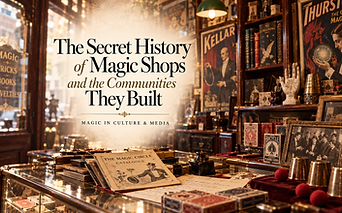
The Secret History of Magic Shops and the Communities They Built
Magic shops were never merely places to buy tricks. For generations, they served as classrooms, meeting places, informal clubs, rumor exchanges, testing grounds, and gateways into an art built partly upon guarded knowledge. From Martinka's shop in New York and Davenports in London to Tannen's and Abbott's, the counter of a magic shop helped connect beginners with professionals, performers with inventors, and isolated enthusiasts with a larger magical community.
September 27, 2026
Follow the Collection
Receive new Stories and collection updates
Receive new Stories, research, acquisitions, and collection updates by email.