
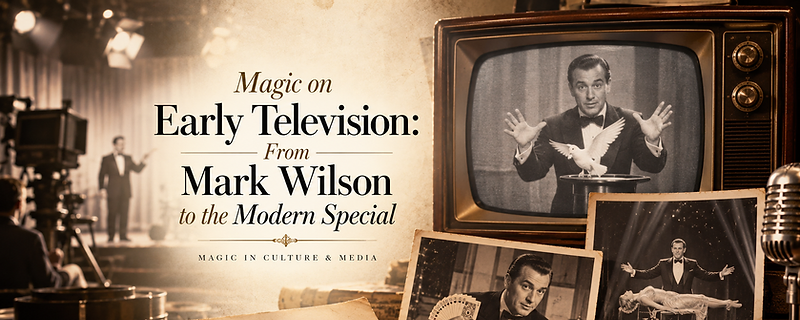
Magic on Early Television: From Mark Wilson to the Modern Special
Long before David Copperfield made the Statue of Liberty disappear or David Blaine brought street magic to prime-time television, magicians were experimenting with a medium that barely existed. From primitive broadcasts in the 1930s to Mark Wilson's groundbreaking national series, Dick Williams's record-setting Magicland in Memphis, Doug Henning's live spectaculars, and the annual television events of the Copperfield era, television created an entirely new chapter in the history of magic.
By The Upchurch Collection of Magic
September 27, 2026
The history of magic on television began earlier than most people realize. Decades before the television special became an annual event, before color broadcasts filled American living rooms, and before anyone could have imagined a magician making the Statue of Liberty disappear for a national audience, performers were already trying to determine whether an art built around live deception could survive being transmitted through a camera.
That question was not trivial. Stage magic had developed under theatrical conditions that magicians understood: a known viewing angle, a physical distance between performer and audience, controlled lighting, and a room full of spectators experiencing the same event together. Television replaced that environment with cameras, directors, monitors, close-ups, edits, and viewers sitting hundreds or thousands of miles away. It also created an entirely new problem of credibility. If the audience knew that television itself could manipulate an image, how could a magician convince viewers that the impossible event had happened in front of the camera rather than inside it?
The history that followed was not simply a story of magicians appearing on television. It was the history of performers learning how to make television itself into a magic venue.
Before Mark Wilson:: Magic Experiments With Television
Magic appeared during television's experimental years, long before the medium became commercially dominant. In September 1932, newspaper schedules announced that vaudeville magician Edwin Howard would bring magic to experimental CBS television station W2XAB in New York. The proposed broadcast included card tricks and what was described as a difficult needle stunt. Surviving schedules show Howard's Television Magic appearing repeatedly that fall, including broadcasts on September 21 and October 5. At a time when television receivers were still experimental curiosities, someone was already trying to discover whether sleight of hand could survive the camera. (Source: Old TV History — September 1932 television schedules).
The pieces were falling into place. Television could show close-up work, manipulation, comedy magic, mentalism, and larger illusions, and a national audience would watch. What had not yet been established was whether a magician could sustain a recurring television program in which magic was not simply one act among many, but the reason viewers tuned in.
That was where Mark Wilson became one of the most important figures in the history of televised magic.
Mark Wilson Proves Magic Can Be a Television Series
Mark Wilson understood television unusually well because he approached magic not only as a performer but as a businessman. After studying marketing at Southern Methodist University, he began developing magic specifically for television. His local Dallas program Time for Magic began in 1955, giving Wilson practical experience with a medium that many established stage performers were still learning to navigate. The Television Academy credits him as the first major television magician and a pioneer in proving the viability of illusion as a television format. (Source: Television Academy — Mark Wilson).
On October 1, 1960, The Magic Land of Allakazam debuted nationally on CBS. Wilson appeared with his wife and co-star Nani Darnell, along with Bev Bergeron as Rebo the Clown and a supporting cast designed for Saturday-morning television. The half-hour program combined sleight of hand, audience participation, comedy, animals, close-up magic, major illusions, and even magical commercials. It remained on CBS for two years before moving to ABC and continued through December 26, 1964. Wilson's own historical materials describe it as the first network television magic series. (Source: Mark Wilson Magic — The Magic Land of Allakazam).
Part of Wilson's importance was his understanding that televised magic depended upon trust. The format was designed to assure viewers that they were seeing the same performance witnessed by the studio audience rather than an illusion manufactured through television technology. That concern would follow television magicians for generations. A theater spectator might suspect a trapdoor, secret assistant, mechanical device, or clever sleight, but a television viewer always had another possible explanation available: the camera did it.
Wilson demonstrated that the problem could be overcome. Just as importantly, he proved that magic could generate enough material, characters, audience interaction, and visual variety to support recurring television. A magician no longer had to wait for an occasional variety-show appearance. Television itself could become the performer's regular stage.
Memphis and the Longest-Running Magic Show in Television History
The national network story is only part of the history. Some of television magic's most remarkable achievements happened locally, where a performer could become part of the weekly life of a particular community.
In Memphis, Tennessee, Dick “Mr. Magic” Williams created a television record that remains extraordinary.
Williams had previously developed a magic program while working in television in Amarillo, Texas. After moving to Memphis and joining WMC-TV as an announcer and weatherman, he revived the concept for his new station. In 1966, Magicland began airing on WMC-TV. What Williams apparently expected might survive only a short time continued until his retirement in 1989: 23 years and approximately 1,200 programs. Guinness World Records recognizes Dick Williams and Magicland for the longest-running television magic show. (Source: Guinness World Records — Longest Running TV Magic Show).
The format was distinctly local television. Magicland was a weekly half-hour program performed before a live studio audience of children, frequently including local Boy Scout and Girl Scout groups. Williams performed tricks and illusions, juggled, interacted with the children, and became a familiar presence to generations of Mid-South viewers. His wife, Virginia Williams, was also integral to the production, appearing with him and contributing to costumes, props, music, assistants, and the work required to produce a new show week after week. (Source: The Daily Memphian — Dick Williams' long-running Magicland set the record).
Its local reach could be remarkable. When WMC aired the 700th episode of Magicland in 1979, the station later reported that the program had captured approximately 70 percent of the local Sunday-morning television audience. That figure is difficult to imagine in today's fragmented media landscape, but it demonstrates how powerful local broadcasting could be when a community had only a handful of television choices. (Source: WMC Action News 5 — Magicland's 700th episode).
For the history of magic, Williams matters for another reason. Television history is often written around national network celebrities, but Magicland demonstrates that regional television created its own traditions, performers, and audiences. Thousands of children in Memphis and the surrounding Mid-South did not experience television magic as an occasional national special. They grew up with the same magician appearing in their homes week after week for more than two decades.
Mark Wilson proved that magic could sustain a national television series. Dick Williams demonstrated how deeply a local magic program could become woven into the culture of a community.
Doug Henning Turns Magic Into a Prime-Time Event
Doug Henning arrived at exactly the right moment. After the success of The Magic Show on Broadway, Henning brought his colorful, youthful presentation to television with Doug Henning's World of Magic, broadcast live on NBC on December 26, 1975. The program included a recreation of Houdini''s Water Torture Cell escape and attracted more than 50 million viewers. Guinness World Records records it as the highest viewing figure for a television magic show. (Source: Guinness World Records — Highest Viewing Figures for a TV Magic Show).
Henning mattered for more than ratings. He looked and felt different from the older stereotype of the formal magician. His clothes, energy, music, staging, and enthusiastic presentation helped make magic feel contemporary to a new generation. The Television Academy notes that World of Magic continued as an annual television event for the following years, helping establish the idea that audiences would return for a major magic broadcast as a recurring prime-time occasion. (Source: Television Academy — Charles Reynolds and Doug Henning's World of Magic).
This was a different relationship with television than the weekly programs of Wilson or Williams. Viewers were no longer necessarily returning every Saturday or Sunday. Instead, the magic special itself became an event. It could be promoted for weeks, built around major illusions, guest stars, elaborate production, and the promise that viewers were about to see something television had never shown them before.
The model was ready for another magician to push it much further.
David Copperfield and the Age of the Annual Special
David Copperfield inherited that television landscape and expanded it dramatically. In 1977, he hosted The Magic of ABC, Starring David Copperfield. His official biography describes the broadcast as the program that introduced his style of magic to millions of television viewers, after which CBS placed him under contract for a continuing series of specials. On October 27, 1978, The Magic of David Copperfield became the first of his CBS specials. (Source: David Copperfield — Official Biography).
Copperfield increasingly treated television as something closer to cinema than a recording of a traditional stage show. Individual illusions could be placed inside stories, filmed at extraordinary locations, supported by music and dramatic production, and built toward a major event advertised weeks in advance. His fourth television special featured the disappearance of a Lear jet. His fifth, broadcast in 1983, culminated with the apparent disappearance of the Statue of Liberty. In 1986, The Magic of David Copperfield in China took the format overseas and climaxed with Copperfield apparently passing through the Great Wall of China. (Source: David Copperfield — Official Biography; UPI Archives — David Copperfield in China).
The annual Copperfield special became its own television ritual. Viewers did not necessarily follow a weekly magic program; instead, they waited to discover what seemingly impossible event would anchor the next broadcast. A jet might vanish. A national monument might disappear. An escape might occur at Alcatraz. The magician might walk through one of the world's most recognizable structures.
In an interesting way, television had recreated the publicity machinery of the great touring illusionists on a national scale. During the Golden Age of Magic, advance publicity and enormous lithographic posters told an entire city that a great magician was coming. Now a television network could tell millions of people that one impossible event was coming at a specific hour on a specific night.
The audience no longer traveled to the spectacle.
The spectacle arrived in the living room.
David Blaine Changes the Language Again
Blaine was in his early twenties, dressed casually, and performed close-up magic for ordinary people in streets and public spaces while a small camera crew documented the encounters. Contemporary coverage emphasized how sharply the program departed from conventional television magic, while Blaine's own retrospective description of the special highlights its decision to turn the camera toward the audience and make the spectators' reactions part of the presentation. (Source: TIME — The Wizard of Grunge; David Blaine — Broadcast History).
The innovation was not street magic itself. Magicians had been performing close-up material in informal settings for generations. What changed was the visual grammar of television. The camera frequently paid as much attention to the spectator as it did to the magician. A person's stunned silence, laughter, confusion, or instinct to walk away became part of the effect. The production style suggested documentary rather than variety television, creating the impression that viewers were witnessing something that had happened spontaneously rather than something constructed on a studio stage.
That approach influenced much of the televised magic that followed. The elaborate set could disappear. The celebrity host was unnecessary. The spectator's reaction could become one of the central visual elements. A deck of cards and a sidewalk could sustain network television if what happened between magician and spectator felt impossible enough.
Once again, television had not simply found a new magician.
It had found a new way to photograph magic.
From the Network Special to the Modern Magic Format
The traditional magic special never disappeared completely, but televised magic increasingly spread across different formats. Performers built documentary-style programs, travel series, competitions, reality formats, and one-off event specials. The line between television magician and stage magician also became less rigid as performers used television exposure to build live careers while established theatrical performers used television to reach audiences far beyond their venues.
Penn & Teller:: Fool Us represents an especially interesting modern development. The format debuted in the United Kingdom in 2011, with an American version premiering on The CW in 2014. Instead of structuring the program around one magician performing for a general audience, Fool Us invited other magicians to perform for Penn & Teller and attempt to deceive two experts. The program made method, originality, and the culture of magicians watching other magicians part of mainstream entertainment without simply exposing the secret of every effect. (Source: Penn & Teller — Fool Us Debuts).
Streaming, online video, and social media have since blurred the definition of a television special even further. A magician can now release a full-length program through a streaming service, distribute individual performances online, or reach millions of viewers without a traditional network schedule. Yet the historical lineage remains visible. Wilson's concern with camera honesty, Dick Williams's relationship with a recurring local audience, Henning's sense of the live television event, Copperfield's cinematic scale, and Blaine's focus on the reactions of ordinary spectators all survive in contemporary screen magic in different forms.
Why Early Television Magic Matters
Looking backward, it is tempting to treat early television magic as a primitive version of what came later. That misses what those performers were actually doing. They were discovering the rules while the medium itself was still being invented.
Edwin Howard was attempting card tricks on experimental television in 1932 when television itself was a novelty. International performers demonstrated that magic could sustain a major network presentation in the 1950s. Mark Wilson proved that a magician could carry a recurring national series. Dick Williams built Magicland into a 23-year Memphis institution and the longest-running television magic program on record. Doug Henning transformed the magic broadcast into a prime-time event. David Copperfield developed the television special into cinematic spectacle. David Blaine stripped much of that spectacle away and demonstrated that a camera pointed at an astonished stranger could be just as powerful.
Each generation solved a different problem presented by the medium.
Together, they created a television history that is now worth preserving in its own right. Recordings, production stills, scripts, promotional photographs, station advertisements, correspondence, props used during broadcasts, newspaper listings, videotapes, and memories from people who sat in studio audiences can document not only individual magicians but an entire period in which an ancient performing art learned to exist inside a new machine.
For many twentieth-century viewers, their first experience of serious magic did not happen in a theater or a magic shop. It happened on a television set in their own home.
And in Memphis, for 23 years, that magician might very well have been Dick “Mr. Magic” Williams.
Continue Reading
Related Stories

Magic in Culture & Media
The Art of the Magic Poster: Selling Wonder Before the Curtain Rose
Long before audiences saw the illusion, they saw the promise. Magic posters transformed performers into larger-than-life figures through color, spectacle, danger, mystery, and sometimes deliberate exaggeration. Today, those advertisements preserve more than beautiful artwork—they reveal how magicians wanted to be seen and how entire generations were persuaded to believe that something extraordinary was coming to town.
September 28, 2026

Magic in Culture & Media
How Television Changed the Way the World Experienced Magic
Before television, most magic had to be experienced in person. A magician traveled to the audience, performed in a theater, nightclub, fairground, or vaudeville house, and disappeared when the engagement ended. Television reversed that relationship. Suddenly the magician could enter millions of homes at once, turning local performers into international personalities and changing not only how magic was presented, but what audiences expected magic to be.
September 28, 2026

Magic in Culture & Media
The Rise of Las Vegas as the Capital of Stage Magic
Las Vegas did not invent stage magic, and it was not always the center of the art. Its importance grew gradually as casino showrooms, resort economics, tourism, television, and purpose-built theaters created something earlier touring illusionists could only have imagined: a city where a magician could stop traveling, install an enormous production permanently, and perform for a new audience night after night. From Gloria Dea and the early Strip to Siegfried & Roy, Lance Burton, David Copperfield, Penn & Teller, Mac King, and Criss Angel, Las Vegas changed not only where magic was performed, but what a professional magician's career could look like.
September 27, 2026

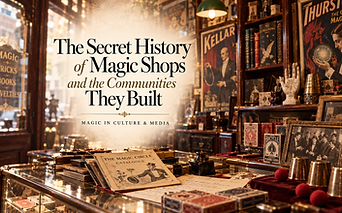
Magic in Culture & Media
The Secret History of Magic Shops and the Communities They Built
Magic shops were never merely places to buy tricks. For generations, they served as classrooms, meeting places, informal clubs, rumor exchanges, testing grounds, and gateways into an art built partly upon guarded knowledge. From Martinka's shop in New York and Davenports in London to Tannen's and Abbott's, the counter of a magic shop helped connect beginners with professionals, performers with inventors, and isolated enthusiasts with a larger magical community.
September 27, 2026
Follow the Collection
Receive new Stories and collection updates
Receive new Stories, research, acquisitions, and collection updates by email.