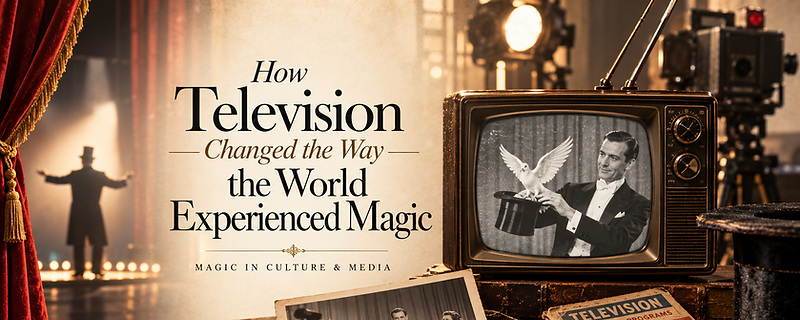
How Television Changed the Way the World Experienced Magic
Before television, most magic had to be experienced in person. A magician traveled to the audience, performed in a theater, nightclub, fairground, or vaudeville house, and disappeared when the engagement ended. Television reversed that relationship. Suddenly the magician could enter millions of homes at once, turning local performers into international personalities and changing not only how magic was presented, but what audiences expected magic to be.
By The Upchurch Collection of Magic
September 28, 2026
For most of magic's history, seeing a magician required being in the right place at the right time. The performer traveled. The audience gathered. An illusion happened in a theater, music hall, fairground, nightclub, or other live venue, and when the engagement ended, the experience survived primarily in memory, printed advertising, photographs, reviews, and whatever physical objects happened to remain.
Television changed that relationship almost completely. Instead of requiring an audience to travel to magic, the magician could suddenly come to the audience. A performance given in one studio could be experienced in thousands—and eventually millions—of homes at the same time. The magician no longer had to be physically present in a town to become familiar there, and a child living hundreds of miles from a major theater could encounter the same performer as someone living in New York, London, or Las Vegas.
That change did far more than increase the size of the audience. It changed the scale of fame, the structure of performances, the kinds of magic people expected to see, and even the relationship of trust between magician and spectator.
Television did not simply broadcast magic.
It created a new kind of magic audience.
When Magic Entered the Living Room
Early television inherited much of its entertainment from older forms. Variety programs naturally included singers, comedians, dancers, novelty acts, ventriloquists, jugglers, and magicians because those performers had already proved capable of holding live audiences. As television became a fixture of domestic life in the middle of the twentieth century, programs such as The Ed Sullivan Show gave specialty entertainers access to audiences far larger than almost any theater could accommodate.
That mattered enormously for magic. A performer who might once have become famous through years of touring could suddenly make an impression on millions of people in a few minutes. Viewers did not need to know the name of a magic theater or deliberately seek out an illusion show. Magic appeared between other forms of popular entertainment and became part of the shared cultural experience of television itself.
The setting also changed the relationship between performer and spectator. At a theater, the magician appeared at a distance, surrounded by a stage, curtains, scenery, music, assistants, and an audience whose reactions helped establish the atmosphere. Television brought the performer into a much more intimate environment. A magician might appear only a few feet tall on a screen sitting in the family living room, yet that performance could reach more people in one evening than generations of earlier performers might have reached during an entire tour.
For many viewers, television became their first encounter with serious magic.
That alone changed the art.
The Camera Became Part of the Performance
Television introduced something a stage magician had never needed to consider in quite the same way: the audience no longer chose where to look.
In a theater, a spectator's eyes can wander. Someone can watch the assistant instead of the magician, glance toward the wings, study the apparatus, or focus on the performer's hands. Television places another person between the magician and the viewer—the director. Camera position, framing, lighting, editing, and the decision about when to cut from one angle to another determine what appears on the screen.
That created tremendous possibilities. Close-up magic could suddenly be shown with a clarity impossible in a large theater. Cards, coins, hands, facial expressions, and small objects could fill the screen. An intimate effect could become dramatic enough for a national audience because the camera placed every viewer only inches away.
Large-scale illusion also benefited. Television production could move beyond the physical boundaries of the traditional stage. A magician could perform outdoors, on city streets, inside unusual buildings, or against landscapes impossible to reproduce in a theater. Television allowed magic to become cinematic.
But the same technology created a problem that television magicians have confronted ever since.
Was the magician doing it, or was the camera helping?
The Problem of Trust
A live audience generally accepts that it is witnessing an illusion under the same physical conditions as everyone else in the room. The spectator may suspect hidden apparatus, misdirection, a secret assistant, or some unknown method, but the basic reality of the event seems secure: something happened in front of them.
Television complicated that assumption.
The moment audiences understood that film could be cut, images could be manipulated, and scenes could be photographed from carefully selected angles, televised magic acquired an additional burden. A remarkable illusion could sometimes produce the opposite reaction from the one the magician wanted: rather than wondering how the trick worked, the viewer could simply conclude that it was done with television.
That distinction became critically important. If audiences believed anything could be created through editing, then an impossible illusion risked becoming less impressive rather than more.
Successful television magicians therefore developed ways of reinforcing credibility. They used visible spectators. They performed in recognizable public locations. They allowed audience members to examine objects, make decisions, or participate directly. Some emphasized that an effect was being performed before a live audience. Others deliberately adopted a stripped-down visual style that made television seem like a witness rather than an accomplice.
This tension between possibility and credibility became one of the defining characteristics of televised magic.
The television camera could make an illusion more extraordinary.
It could also make audiences trust it less.
The Magic Special Changed the Scale of the Art
By the 1970s and 1980s, television was no longer simply a place where magicians appeared for short segments. The medium increasingly supported programs built entirely around magic, allowing performers to construct an hour of entertainment specifically for the screen.
Doug Henning played an important role in bringing a colorful, contemporary sensibility to televised magic at a time when the stereotypical image of the magician could still feel connected to an earlier theatrical era. His appearance and presentation suggested that magic did not have to remain trapped in formal evening dress, Victorian imagery, or the visual vocabulary of old stage illusion.
David Copperfield subsequently demonstrated just how powerful the television special could become.
Copperfield's specials did not merely record a stage show. Television itself became part of the storytelling. Music, location filming, editing, dramatic photography, comedy, romantic presentation, and large-scale illusion were combined into something much closer to cinematic entertainment. The format allowed individual illusions to exist within carefully created emotional worlds.
Some of the resulting images became inseparable from Copperfield's public identity: walking through the Great Wall of China, apparently escaping from Alcatraz, flying through the air, surviving dramatic physical challenges, and famously making the Statue of Liberty appear to vanish.
Whether a viewer ever attended a David Copperfield show became almost irrelevant to his cultural reach. Millions knew what a David Copperfield illusion looked and felt like because television had delivered it directly into their homes.
That represented a profound change from the era of the touring poster.
The poster promised that something extraordinary would happen if you came to the theater.
Television showed it to you.
Television Created Different Kinds of Magicians
Television also helped destroy the idea that a successful magician had to look or perform in one particular way.
Paul Daniels became one of Britain's most recognizable television personalities by combining magic with humor and an approachable presentation. Penn & Teller used television to challenge the conventions of magic itself, mixing illusion with skepticism, comedy, explanation, and deliberate confrontation with the traditions of the profession. Their success demonstrated that a magician could build a television identity not merely by performing mysteries, but by having a distinctive point of view about magic.
Then came performers such as David Blaine, whose television work changed the visual grammar again. Instead of elaborate sets and glamorous stage production, Blaine's early specials placed him on streets and sidewalks, often dressed casually and performing extremely direct magic for apparently ordinary people. The reactions of spectators became almost as important as the tricks themselves. The television audience was invited to watch not only the impossible event but the moment another person tried to process what had just happened.
The contrast with the classic television special was enormous. Copperfield could use television to make magic larger. Blaine used it to make magic feel closer.
Derren Brown used the medium differently again, building extended programs around psychological presentation, suggestion, prediction, decision-making, and carefully structured narratives. Television was no longer simply displaying isolated tricks. It could sustain an idea across an entire program.
Each approach expanded the definition of what a television magician could be.
Television Made Reactions Part of the Magic
One of television's less obvious contributions was its ability to show the audience watching the audience.
In a live theater, spectators hear laughter, applause, gasps, and occasionally screams around them. Those reactions influence the experience, but most people are still looking toward the stage. Television can turn the camera away from the magician at the critical moment and show someone else's face.
A spectator's expression of confusion, fear, disbelief, or delight becomes part of the presentation.
This became especially important as magic moved into streets, restaurants, homes, and other informal locations. The effect itself might last only seconds, but the camera could linger on the aftermath: someone staring at their hands, laughing nervously, backing away, or looking toward friends for an explanation.
Television discovered that wonder has a face.
That discovery influenced generations of magic programming. Modern audiences have become so accustomed to reaction shots that they can be easy to overlook, but they represent a significant shift. The television viewer is not merely shown the magician's performance. The viewer is shown how another human being experiences it.
In that way, television partially recreates something otherwise lost when magic leaves the theater: the emotional presence of the crowd.
From National Fame to Global Influence
Television also accelerated the spread of ideas within magic itself. Before mass broadcasting, performers learned through books, magazines, clubs, conventions, personal relationships, dealers, and by seeing other magicians perform. Television added another route.
A young magician could now encounter performers and styles that might never have visited their city.
A successful television appearance could influence costumes, pacing, music, staging, presentation, and even the kinds of effects magicians wanted to learn. When programs crossed national borders or were later distributed internationally, the influence extended far beyond the country in which they were produced.
This produced a kind of feedback loop. Magicians influenced television, television influenced audiences, audience expectations influenced other magicians, and those performers created new programs that carried the art in different directions again.
The result was a faster exchange of styles than earlier generations had experienced.
Television helped make magic international not simply because performers could become internationally famous, but because magicians around the world could increasingly watch one another.
What Television Preserved — and What It Changed
For historians, television created another remarkable consequence: performances survived in a form earlier generations rarely enjoyed.
A poster can tell us how a magician was advertised. A photograph can show us a costume or apparatus. A program can document the structure of a show. A review may describe what an audience saw.
A television recording can preserve the performance itself.
Not perfectly, of course. The camera chooses the viewpoint. Editing alters time. Music and production affect the experience. A person watching an old broadcast decades later is not having the same experience as someone who saw it when it first aired.
But we can still observe how a magician moved, spoke, timed a revelation, interacted with volunteers, structured an illusion, responded to laughter, and presented themselves to the public.
Those details are invaluable.
Televised magic therefore occupies an unusual position in preservation. Television changed the performance, but it also created a record of that changed performance.
The medium that made magic more ephemeral in one sense—something broadcast and then immediately replaced by next week's programming—ultimately preserved enormous portions of twentieth-century magic history.
From Television to the Screen in Your Hand
The technological descendants of televised magic are now everywhere.
Streaming services, online video, social media, and smartphones have removed many of the limits that once governed television. A performer no longer needs access to a network or a national television special to reach a global audience. A single piece of magic recorded on a telephone can be viewed millions of times around the world within days.
But many of the questions created by television remain unchanged.
Is the effect genuine within the conditions being presented, or has the video been manipulated?
Does the camera document the magic or create it?
Is the spectator's reaction authentic?
Does an illusion become more powerful when seen close-up, or does the screen create distance between performer and audience?
And what happens when viewers can pause, rewind, slow down, enlarge, and replay something that once existed only for an instant?
The technology has changed.
The negotiation between mystery and trust has not.
Magic Without Geography
Perhaps television's greatest transformation was also its simplest.
It removed geography from the equation.
A child did not have to live near a major theater to see David Copperfield. A family did not have to purchase tickets to encounter a magician on a variety program. Someone who had never attended a magic convention or walked into a magic shop could discover an entire art form without leaving the living room.
For countless people, the first magician they remember was not standing in front of them.
The magician was inside a television set.
That experience was different from live magic. The viewer could not inspect the stage, volunteer, choose where to look, or feel the physical presence of hundreds of people reacting together. The screen was always a barrier between the audience and the impossible event.
But it was also a bridge.
Television allowed wonder to travel farther than any touring company ever could. It transformed individual performers into cultural figures, preserved performances that might otherwise have disappeared, inspired future magicians who lived nowhere near the traditional centers of the art, and continually forced magic to reinvent itself for new audiences.
The theater asked people to come to the magician.
Television brought the magician home.
Continue Reading
Related Stories

Magic in Culture & Media
The Art of the Magic Poster: Selling Wonder Before the Curtain Rose
Long before audiences saw the illusion, they saw the promise. Magic posters transformed performers into larger-than-life figures through color, spectacle, danger, mystery, and sometimes deliberate exaggeration. Today, those advertisements preserve more than beautiful artwork—they reveal how magicians wanted to be seen and how entire generations were persuaded to believe that something extraordinary was coming to town.
September 28, 2026

Magic in Culture & Media
Magic on Early Television: From Mark Wilson to the Modern Special
Long before David Copperfield made the Statue of Liberty disappear or David Blaine brought street magic to prime-time television, magicians were experimenting with a medium that barely existed. From primitive broadcasts in the 1930s to Mark Wilson's groundbreaking national series, Dick Williams's record-setting Magicland in Memphis, Doug Henning's live spectaculars, and the annual television events of the Copperfield era, television created an entirely new chapter in the history of magic.
September 27, 2026


Magic in Culture & Media
The Rise of Las Vegas as the Capital of Stage Magic
Las Vegas did not invent stage magic, and it was not always the center of the art. Its importance grew gradually as casino showrooms, resort economics, tourism, television, and purpose-built theaters created something earlier touring illusionists could only have imagined: a city where a magician could stop traveling, install an enormous production permanently, and perform for a new audience night after night. From Gloria Dea and the early Strip to Siegfried & Roy, Lance Burton, David Copperfield, Penn & Teller, Mac King, and Criss Angel, Las Vegas changed not only where magic was performed, but what a professional magician's career could look like.
September 27, 2026


Magic in Culture & Media
The Secret History of Magic Shops and the Communities They Built
Magic shops were never merely places to buy tricks. For generations, they served as classrooms, meeting places, informal clubs, rumor exchanges, testing grounds, and gateways into an art built partly upon guarded knowledge. From Martinka's shop in New York and Davenports in London to Tannen's and Abbott's, the counter of a magic shop helped connect beginners with professionals, performers with inventors, and isolated enthusiasts with a larger magical community.
September 27, 2026
Follow the Collection
Receive new Stories and collection updates
Receive new Stories, research, acquisitions, and collection updates by email.