
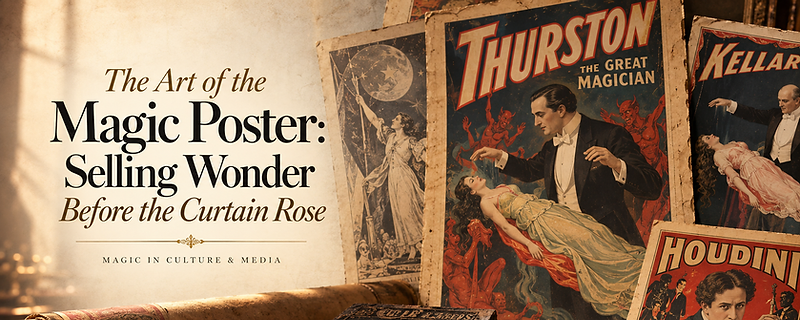
The Art of the Magic Poster: Selling Wonder Before the Curtain Rose
Long before audiences saw the illusion, they saw the promise. Magic posters transformed performers into larger-than-life figures through color, spectacle, danger, mystery, and sometimes deliberate exaggeration. Today, those advertisements preserve more than beautiful artwork—they reveal how magicians wanted to be seen and how entire generations were persuaded to believe that something extraordinary was coming to town.
By The Upchurch Collection of Magic
September 28, 2026
Before the first drumroll sounded or the curtain opened, the magician's first illusion was often already hanging on a wall.
A poster could show a man surrounded by devils, spirits, skulls, chains, floating bodies, impossible machines, or scenes no stage could literally reproduce. It might depict the magician as a master of hidden forces, an escape artist defying death, or an elegant figure standing calmly at the center of chaos. To someone passing it on a city street, the message was immediate: something extraordinary was coming to town.
During the late nineteenth and early twentieth centuries, when traveling magicians competed with circuses, theaters, vaudeville acts, exhibitions, and countless other forms of entertainment, the poster had an important job. It had to interrupt everyday life. It had to catch someone's attention from across a street, create curiosity in a matter of seconds, and make a performance that had not yet happened feel like an event that could not be missed.
The best magic posters did something even more interesting. They did not simply advertise wonder.
They began creating it before the audience ever bought a ticket.
When Advertising Became Spectacle
Early advertisements for conjurors were often relatively simple affairs dominated by typography. Names, dates, venues, testimonials, lists of astonishing feats, and claims of distinction could fill the page. The language did much of the work, promising strange experiments, impossible transformations, supernatural-looking phenomena, or feats never before witnessed.
Advances in color lithography gradually changed what theatrical advertising could accomplish. Printing companies such as Strobridge Lithographing Company in Cincinnati and Otis Lithograph Company in Cleveland became associated with richly illustrated theatrical and entertainment advertising, allowing promoters to fill public spaces with increasingly elaborate images. By the end of the nineteenth century, the magic poster could operate almost like a miniature stage production of its own. Bold colors, exaggerated scale, theatrical lighting, supernatural imagery, portraits of the performer, and carefully arranged scenes told the viewer what kind of experience to expect before a single word of promotional copy was read.
This visual approach was particularly useful for touring performers. A long paragraph of English advertising copy had limited value in a city where much of the audience spoke another language. A dramatic image did not have the same problem. Chains suggested escape. A floating woman suggested levitation. Devils and spirits suggested forbidden knowledge. A magician calmly surrounded by impossible events suggested mastery over all of it.
The poster became a form of visual shorthand for wonder.
Selling the Magician as Much as the Magic
Perhaps the most fascinating thing about these posters is that they were rarely selling only individual tricks. They were selling a person.
Long before entertainers spoke about personal branding, magicians understood the importance of creating a recognizable public identity. Their names appeared in enormous lettering. Portraits were idealized. Costumes, poses, colors, symbols, and slogans repeated from city to city until the performer and the image became inseparable.
Harry Kellar provides one of the most memorable examples. Posters associated with Kellar frequently surrounded him with devils, imps, spirits, and other supernatural imagery. The suggestion was mischievous rather than purely sinister: here was a man apparently comfortable in the company of forces ordinary people could neither see nor control. The imagery gave visual form to an old theatrical idea—that the magician possessed access to knowledge unavailable to everyone else.
The audience did not have to believe Kellar was literally communicating with supernatural beings. In some ways, it worked better if they did not. The poster invited people into the game. It created an atmosphere in which forbidden knowledge, mystery, and impossible events seemed to surround the performer before the show had even begun.
Other magicians cultivated different identities. Some emphasized elegance and sophistication. Others presented themselves as mysterious visitors from distant places or masters of exotic knowledge. Grand illusionists surrounded themselves with spectacular apparatus, assistants, and impossible stage scenes. Mentalists emphasized the mind, hypnotic influence, or penetrating eyes. The image told audiences not merely what the magician did, but what kind of magician they were about to meet.
Houdini Sold Something Different
Harry Houdini illustrates how dramatically the visual language of magic advertising could change when a performer changed the central promise.
Much of Houdini's public image moved away from the supernatural atmosphere that appeared so prominently in the advertising of some earlier magicians. Chains, handcuffs, locks, ropes, cells, boxes, water, confinement, and physical danger became central elements of his imagery. The drama was easier to understand immediately: Houdini was the man who could not be held.
That distinction mattered because his posters were not merely advertising the mechanism of an escape. They were advertising a conflict.
Houdini versus the handcuffs.
Houdini versus the jail cell.
Houdini versus the water.
Houdini versus the apparent limits of the human body.

The viewer could understand the story without understanding anything about magic. Confinement was familiar. Escape was universally understandable. The harder the situation looked, the more extraordinary Houdini appeared for surviving it.
That is one of the great lessons of theatrical advertising. The most effective image does not necessarily explain the performance. It gives the audience a reason to care about what happens.
Devils, Skeletons and the Language of Mystery
To modern eyes, some classic magic posters can appear almost bizarre. Devils whisper into a magician's ear. Ghosts hover overhead. Skeletons emerge from darkness. Strange creatures watch from the edges of the composition while the magician remains perfectly calm.
That imagery was not accidental.
Magic occupied an unusual cultural position. The audience generally understood that it was attending a performance, yet the attraction depended upon the temporary appearance that ordinary rules had been suspended. Posters could exploit that tension much more aggressively than the performance itself. The artist did not have to explain how an illusion worked or even depict something that would literally happen onstage. The poster needed to communicate a feeling.
Mystery.
Danger.
Forbidden knowledge.
Power.
The impossible.
The result was a visual vocabulary so distinctive that many historic magic posters remain immediately recognizable as magic advertising even when the viewer has never heard of the performer. In this sense, the poster artists helped create part of magic's public identity. They established a world in which red devils, black backgrounds, staring eyes, elegant evening clothes, glowing spirits, elaborate machinery, and impossible bodies all belonged naturally together.
Selling the Arrival
The poster also belonged to a much larger machinery of theatrical promotion. Touring entertainment required advance work. Representatives could arrive before the performer, arrange publicity, work with theaters and local contacts, distribute printed material, and build anticipation before the company itself reached town. Posters and bills placed throughout heavily traveled areas made the coming attraction difficult to ignore.
This mattered enormously in an era before television advertising, social media, email lists, and instant online ticketing. A magician arriving in a new city often had a limited period in which to turn an unfamiliar population into paying customers. Repetition created familiarity. A person might pass one poster on the way to work, encounter another near a shop, and see the performer's name again outside the theater. By the time the show opened, the magician could feel strangely familiar even to someone who had never seen the act.
The campaign therefore created something modern marketers still try to manufacture: anticipation.
The show had not happened yet, but the audience had already begun imagining it.
That may have been the poster's greatest trick.
The Poster Was Never Meant to Become an Artifact
There is an irony in the fact that historic magic posters are now carefully framed, conserved, collected, studied, and sometimes sold for substantial sums.
They were advertising.
Most were created to do a job for a limited period of time. They were shipped, handled, folded or rolled, posted in windows, pasted onto walls, exposed to sunlight and weather, covered by later advertisements, or discarded once the engagement had passed. Their survival was never guaranteed because survival was not their purpose.
That is precisely what makes surviving examples so valuable as historical evidence.
A poster can preserve the name of a theater that no longer exists. It can help establish where a performer appeared and how an act was promoted at a particular moment. Changes in imagery can reveal changes in a performer's career. Printer information can connect a piece to the broader history of commercial printing. Portraits document costumes and public personas, while promotional claims reveal what producers believed would attract an audience.
Even exaggeration tells us something.
If a poster promised the greatest magician on Earth, the most dangerous escape ever attempted, or an unprecedented mystery never before witnessed by human eyes, historians do not have to accept the claim literally for the advertisement to be useful. The exaggeration itself tells us how wonder was being sold.
Why Condition Is Not the Whole Story
Collectors naturally value beautiful examples. Strong color, intact margins, minimal fading, and limited damage make a historic poster visually impressive. But historical importance and physical perfection are not always the same thing.
A poster with folds, mounting marks, tears, or evidence of actual display may have lived the life it was created to live. In some cases, those imperfections form part of its history. A date written on the reverse, a theater stamp, a printer's mark, or evidence that the piece was once posted publicly may add information that a pristine but poorly documented example cannot provide.
As with other objects in a serious collection, provenance and context matter. Knowing where a poster came from, when it was used, what production it advertised, and how it survived can transform an attractive piece of paper into a much richer historical record.
The goal of preservation should not be to erase that history in pursuit of something that looks new. A century-old poster does not have to pretend it was printed yesterday.
Sometimes its age is part of what makes it worth preserving.
More Than Famous Posters
The spectacular lithographs associated with performers such as Houdini, Kellar, Thurston, and other major figures understandably receive enormous attention. They are visually powerful, historically important, and closely connected to some of the best-known personalities in magic.
But the same preservation principle applies to far less glamorous material.
A poster from a regional magician may be one of the few surviving records of that performer's career. A cheaply printed window card may document a show that received no newspaper coverage. A handbill could preserve the name of an assistant who disappeared from the historical record. A modern signed poster from a touring illusionist may seem commonplace today but become considerably more useful to historians after the show has closed, the venue has changed, and firsthand memories have begun disappearing.
This is one reason The Upchurch Collection of Magic does not view posters merely as wall decoration. Famous lithographs deserve preservation, but so do selected examples from the wider working world of magic. Together, they reveal not only who became famous, but how magic was actually presented to audiences across different periods, places, and levels of the profession.
Selling Wonder Before the Curtain Rose
The technology of promotion has changed almost beyond recognition. A performer today can announce a show through social media, release a video trailer, purchase targeted advertising, email previous customers, appear on podcasts, and sell tickets directly from a telephone screen.
The old poster no longer carries the burden it once did.
Yet its fundamental purpose has not disappeared.
Every successful piece of entertainment advertising still attempts to do what the best magic posters were doing more than a century ago: make an audience imagine an experience it has not yet had.
That is why these posters matter beyond their beauty.
They document how magicians wanted to be seen. They reveal what audiences were expected to find mysterious, dangerous, exotic, elegant, thrilling, or impossible. They preserve forgotten venues, touring routes, printers, artistic conventions, performers, and individual moments in the evolution of famous careers. And they show us how an ephemeral performance could begin taking shape in the imagination of an audience days or weeks before anyone entered the theater.
Long before the magician appeared beneath the lights, someone walking down a street had already stopped in front of an image and wondered what they might see if they bought a ticket.
The poster had done its job.
Before the curtain rose, wonder had already been sold.
Continue Reading
Related Stories

Magic in Culture & Media
How Television Changed the Way the World Experienced Magic
Before television, most magic had to be experienced in person. A magician traveled to the audience, performed in a theater, nightclub, fairground, or vaudeville house, and disappeared when the engagement ended. Television reversed that relationship. Suddenly the magician could enter millions of homes at once, turning local performers into international personalities and changing not only how magic was presented, but what audiences expected magic to be.
September 28, 2026

Magic in Culture & Media
Magic on Early Television: From Mark Wilson to the Modern Special
Long before David Copperfield made the Statue of Liberty disappear or David Blaine brought street magic to prime-time television, magicians were experimenting with a medium that barely existed. From primitive broadcasts in the 1930s to Mark Wilson's groundbreaking national series, Dick Williams's record-setting Magicland in Memphis, Doug Henning's live spectaculars, and the annual television events of the Copperfield era, television created an entirely new chapter in the history of magic.
September 27, 2026

Magic in Culture & Media
The Rise of Las Vegas as the Capital of Stage Magic
Las Vegas did not invent stage magic, and it was not always the center of the art. Its importance grew gradually as casino showrooms, resort economics, tourism, television, and purpose-built theaters created something earlier touring illusionists could only have imagined: a city where a magician could stop traveling, install an enormous production permanently, and perform for a new audience night after night. From Gloria Dea and the early Strip to Siegfried & Roy, Lance Burton, David Copperfield, Penn & Teller, Mac King, and Criss Angel, Las Vegas changed not only where magic was performed, but what a professional magician's career could look like.
September 27, 2026

Magic in Culture & Media
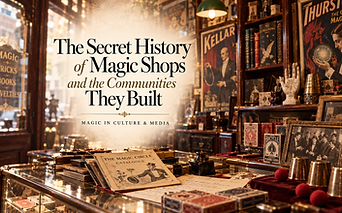
The Secret History of Magic Shops and the Communities They Built
Magic shops were never merely places to buy tricks. For generations, they served as classrooms, meeting places, informal clubs, rumor exchanges, testing grounds, and gateways into an art built partly upon guarded knowledge. From Martinka's shop in New York and Davenports in London to Tannen's and Abbott's, the counter of a magic shop helped connect beginners with professionals, performers with inventors, and isolated enthusiasts with a larger magical community.
September 27, 2026
Follow the Collection
Receive new Stories and collection updates
Receive new Stories, research, acquisitions, and collection updates by email.