
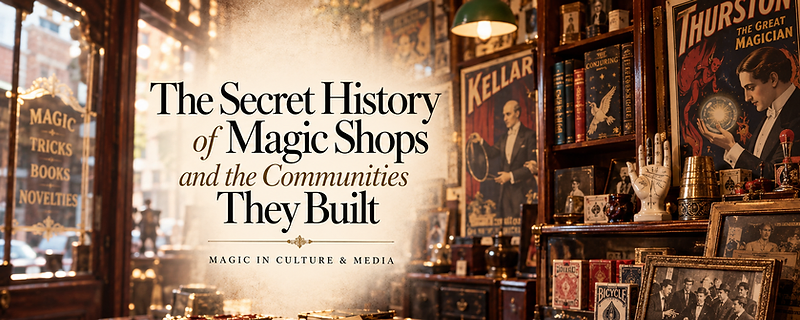
The Secret History of Magic Shops and the Communities They Built
Magic shops were never merely places to buy tricks. For generations, they served as classrooms, meeting places, informal clubs, rumor exchanges, testing grounds, and gateways into an art built partly upon guarded knowledge. From Martinka's shop in New York and Davenports in London to Tannen's and Abbott's, the counter of a magic shop helped connect beginners with professionals, performers with inventors, and isolated enthusiasts with a larger magical community.
By The Upchurch Collection of Magic
September 27, 2026
To someone walking in from the street, an old-fashioned magic shop might have looked like a peculiar retail store. There were decks of cards, brightly painted boxes, silks, books, coins, linking rings, mechanical apparatus, novelty items, and objects whose purposes were not immediately obvious. But the merchandise tells only part of the story. For much of the nineteenth and twentieth centuries, the most important thing a magician could find in a magic shop was not necessarily something for sale. It was another magician.
Before online video, internet forums, social media, instant downloads, and overnight shipping, learning magic could be surprisingly difficult. Books were available, and professional performers sometimes taught students, but much of the art circulated through personal relationships. A beginner needed to know which book to read, which sleight was worth months of practice, which trick looked better in the catalog than it did in reality, and what professional performers actually used. A knowledgeable dealer could answer those questions. So could the older magician standing at the counter. The shop became a place where information passed from one generation to another, often through conversations that were never written down.
The Magic Dealer Was Selling More Than Apparatus
Magic has always created an unusual retail problem: the customer often cannot know exactly what is being purchased until after buying it. A catalog can describe the effect—perhaps a borrowed ring disappears and is found somewhere impossible—but revealing too much about the method defeats part of the purpose. Historically, reputable dealers therefore depended heavily upon trust. Customers needed confidence that an advertised effect was practical, properly made, and honestly described.
The best dealers also became teachers and filters. They learned the customer's ability level. A beginner asking for an advanced sleight-of-hand routine might be directed toward a simpler book or trick first. A working professional might be shown something new before it appeared in a catalog. Visiting magicians demonstrated routines, discussed alterations to apparatus, and compared approaches to presentation. Manufacturers heard directly from performers about what worked and what needed to be improved.
That social function helped make the magic shop different from an ordinary novelty store. The object being sold mattered, but so did the knowledge surrounding it. A wooden box without explanation might be meaningless. In the hands of a magician who understood its handling, timing, presentation, and history, it became an illusion.
Martinka's and the Birth of an Institution
One of the most important American examples was Martinka & Co. in New York. Founded in the nineteenth century by brothers Francis and Antonio Martinka, the business became one of the best-known magic dealers in the United States and a gathering place for professional and amateur magicians. Its historical importance goes far beyond the apparatus it sold.
On May 10, 1902, a group of magicians gathered at Martinka's shop and founded the Society of American Magicians. The S.A.M. still identifies Martinka's as the location of its founding and describes itself as the world's oldest continuing magic organization. Harry Houdini later became one of its most famous presidents. (Source: Society of American Magicians — About the S.A.M..)
That meeting illustrates what magic shops could become. A retail business provided the physical place where performers who might otherwise encounter one another only backstage or by correspondence could regularly gather. Relationships formed. Ideas circulated. Organizations emerged. The shop helped turn scattered practitioners into a community.
The merchandise on the shelves was therefore only the visible part of the institution. The conversations around the counter could have consequences lasting much longer than the tricks being sold.
Davenports and the Continuity of a Magical Family
Across the Atlantic, Davenports became one of the great names in British magic dealing. The Davenport family established its magic business in London in 1898, and the company describes itself as a central London magic shop and school dating from that year. Its longevity alone makes it remarkable: the business spans the era of the great music halls, two world wars, radio, television, the rise of modern close-up magic, home video, and the internet. (Source: Davenports Magic)
A business capable of surviving that kind of change inevitably becomes more than a store. Generations of magicians passed through its doors. Beginners encountered books and apparatus they had previously known only through advertisements. Professionals could exchange news, demonstrate ideas, and maintain connections with the wider magical world. Dealers who remained in the business for decades developed extraordinary institutional memories: who invented an effect, who first sold it, which performer used it, which version worked best, and which apparently new idea had actually appeared thirty years earlier.
That kind of memory is difficult to catalog because much of it exists orally. When a historic magic shop closes, a community does not merely lose a place to purchase tricks. It can lose accumulated knowledge that lived in the people behind the counter.
Tannen's and the New York Magic Community
In 1925, Louis Tannen founded Tannen's Magic Shop in New York City. The company, which remains in operation, describes itself as the oldest operating magic shop in New York and emphasizes its century-long role as a gathering place where magicians could discover new material, practice, and connect with one another. (Source: Tannen's Magi)
Tannen's became part of a particularly rich New York magic culture. A young magician entering the shop might encounter books, tricks, dealers, lecturers, local performers, visiting professionals, and other young people trying to learn the same art. The social hierarchy of magic could suddenly become much smaller. Someone whose name appeared on a book or advertisement might be standing only a few feet away.
The shop's influence eventually extended beyond retail through lectures and education. Tannen's Magic Camp, begun in 1974, created a structured environment in which young magicians could learn from experienced performers and, equally important, from one another. The company notes alumni including David Blaine and Michael Carbonaro.. The idea behind the camp reflects the same principle that had always made the physical shop important: magic develops unusually well in communities where people can watch, practice, discuss, fail, improve, and exchange ideas face to face. (Source: Tannen's Magic)
A trick can be shipped anywhere.
A community has to be built.
Abbott's Turns a Small Town Into a Magic Destination
Perhaps nowhere is the relationship between magic dealer and community more visible than Colon, Michigan. Harry Blackstone Sr. owned property in the area and invited fellow magicians there, including the English magician Percy Abbott. Abbott and Blackstone briefly became business partners before separating. In January 1934, Percy Abbott opened what became the Abbott Magic Company, and Recil Bordner soon joined the business. That September, Abbott and Bordner held an open house for magicians that became the first Abbott Magic Get-Together. Abbott's records that approximately eighty magicians attended the original event. (Source: Abbott's Magic — Abbott's History)
The gathering continued and grew into one of the enduring traditions of American magic. Colon eventually became known as the “Magic Capital of the World,” a nickname Abbott's traces to the influence the company and its annual gathering had upon the community. For several days each year, magicians descend on a small Michigan village for shows, lectures, dealers, street performances, conversations, reunions, and the simple experience of being surrounded by people who share the same unusual interest. (Source: Abbott's Magic Shop)
Abbott's shows what can happen when a magic shop develops enough cultural gravity. The community begins forming around the business rather than merely entering it. The factory, store, annual convention, performers, visitors, local history, and town itself become interconnected. A retailer of magical apparatus helped create a geographic destination for magicians.
Few other industries could plausibly transform a village into part of the folklore of an art form.
What Happened Around the Counter
The social culture of a magic shop was rarely formal. There was no curriculum posted on the wall explaining what the beginner would learn that afternoon. Much of the education happened simply by remaining there long enough.
Someone demonstrated a double lift.
Another magician explained why the move was being done incorrectly.
A professional walked in and showed a routine from the previous night's show.
A dealer opened a drawer and produced an apparatus no longer being manufactured.
Someone mentioned that an apparently new trick was based on something published decades earlier.
Stories circulated about famous performers, disastrous shows, stolen methods, brilliant presentations, impossible clients, forgotten inventors, and legendary conventions. Some of the stories were accurate. Others grew better with each telling. Both became part of magic culture.
The counter could also enforce professional norms. Exposure of secrets, copying another performer's act, failing to credit an inventor, or performing material beyond one's ability could all become topics of conversation. Young magicians learned not only methods but expectations about how magicians were supposed to behave.
That education was imperfect. Magic shops could be cliquish. Beginners could feel intimidated. Women and minorities were not always welcomed equally within older magic communities, just as they were not always welcomed equally within magic societies and professional circuits. Personal feuds sometimes divided local scenes. Dealers had commercial interests, and not every piece of advice was impartial.
But even those imperfections demonstrate the larger point: these were communities of people rather than warehouses of merchandise.
Catalogs Created Communities at a Distance
The influence of the magic shop extended far beyond anyone who could physically visit.
Mail-order catalogs carried the dealer's counter into towns where no magic shop existed. A young magician might study a catalog repeatedly, memorizing the names of effects and imagining what the mysterious apparatus actually did. Dealers such as Abbott's, Tannen's, Davenports, Thayer, and others could reach customers hundreds or thousands of miles away.
Those catalogs now have historical value far beyond their original commercial purpose. They document prices, manufacturers, terminology, popular tricks, changing fashions, and the commercial life cycle of apparatus. Comparing editions can reveal when an effect appeared, how long it remained available, how the advertising language changed, and what magicians of a particular period were being encouraged to buy.
The catalog also offered an isolated magician proof that a larger world existed.
Somewhere there were enough people interested in linking rings, billiard balls, card sleights, spirit cabinets, handcuffs, silk productions, and mechanical tables to support an entire business devoted to them.
For a child learning magic in a small town, that realization could be enormously important.
The Internet Changed the Shop—but Not the Need for Community
The internet transformed nearly everything about magic retail. A magician can now watch a trailer, purchase an effect, receive a video explanation, read reviews, compare prices, ask questions in an online group, and have the physical product delivered without ever speaking to another magician.
The advantages are obvious. Information that once required access to a major city or specialized dealer is available almost anywhere. Creators can sell directly to performers around the world. Rare books can be located in seconds. Historical performances that once survived only in private film collections can sometimes be watched online.
Something was lost as well.
A video trailer is unlikely to tell a beginner, “You are not ready for this yet.”
An online shopping cart does not ask what kind of performer you want to become.
An algorithm can recommend another product. It cannot easily reproduce the afternoon spent at a counter while three experienced magicians disagree about the best way to perform the trick you just bought.
The decline of brick-and-mortar magic shops therefore represents more than a change in retail. It is part of a broader shift in how magical knowledge and community are transmitted. Some of that community has migrated successfully to conventions, clubs, magic schools, private groups, online forums, social media, and places such as the Magic Castle. But the traditional magic shop occupied a peculiar middle ground that is difficult to duplicate: commercial enough to remain open, informal enough to drop into without an appointment, and specialized enough that almost everyone entering the room already shared an interest.
Why Magic-Shop History Belongs in a Magic Collection
The history of a magic shop survives through many of the same objects that once seemed disposable: catalogs, instruction sheets, dealer advertisements, invoices, envelopes, postcards, price lists, tokens, photographs, letters, apparatus labels, business cards, and correspondence between dealers and performers.
These items can establish where a trick was sold, what it originally cost, who manufactured it, how it was described, and when it entered the market. A dealer's label attached to an old apparatus may help identify an object that would otherwise be mysterious. A letter from a magician ordering a particular illusion can become provenance for the apparatus itself. A catalog can establish that a supposedly modern trick was commercially available generations earlier.
But these materials also preserve something less tangible: evidence that magic was a social world.
A photograph of magicians crowded into a shop records relationships. A convention program reveals who gathered there. An inscription in a dealer's catalog may identify its owner. A handwritten note from a shopkeeper can preserve advice exchanged between people who have been dead for decades.
For The Upchurch Collection of Magic, that history matters because preserving magic should mean more than preserving famous magicians and spectacular props. The art was also sustained by the places where magicians learned who came before them, where beginners discovered that professionals were real people, and where secrets moved carefully from one set of hands to another.
The great theaters preserved the public face of magic.
The magic shops preserved much of the community behind it.
A person might enter looking for a trick.
What they sometimes found was an entire world.
Continue Reading
Related Stories

Magic in Culture & Media
The Art of the Magic Poster: Selling Wonder Before the Curtain Rose
Long before audiences saw the illusion, they saw the promise. Magic posters transformed performers into larger-than-life figures through color, spectacle, danger, mystery, and sometimes deliberate exaggeration. Today, those advertisements preserve more than beautiful artwork—they reveal how magicians wanted to be seen and how entire generations were persuaded to believe that something extraordinary was coming to town.
September 28, 2026

Magic in Culture & Media
How Television Changed the Way the World Experienced Magic
Before television, most magic had to be experienced in person. A magician traveled to the audience, performed in a theater, nightclub, fairground, or vaudeville house, and disappeared when the engagement ended. Television reversed that relationship. Suddenly the magician could enter millions of homes at once, turning local performers into international personalities and changing not only how magic was presented, but what audiences expected magic to be.
September 28, 2026

Magic in Culture & Media
Magic on Early Television: From Mark Wilson to the Modern Special
Long before David Copperfield made the Statue of Liberty disappear or David Blaine brought street magic to prime-time television, magicians were experimenting with a medium that barely existed. From primitive broadcasts in the 1930s to Mark Wilson's groundbreaking national series, Dick Williams's record-setting Magicland in Memphis, Doug Henning's live spectaculars, and the annual television events of the Copperfield era, television created an entirely new chapter in the history of magic.
September 27, 2026

Magic in Culture & Media
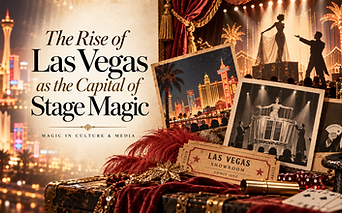
The Rise of Las Vegas as the Capital of Stage Magic
Las Vegas did not invent stage magic, and it was not always the center of the art. Its importance grew gradually as casino showrooms, resort economics, tourism, television, and purpose-built theaters created something earlier touring illusionists could only have imagined: a city where a magician could stop traveling, install an enormous production permanently, and perform for a new audience night after night. From Gloria Dea and the early Strip to Siegfried & Roy, Lance Burton, David Copperfield, Penn & Teller, Mac King, and Criss Angel, Las Vegas changed not only where magic was performed, but what a professional magician's career could look like.
September 27, 2026
Follow the Collection
Receive new Stories and collection updates
Receive new Stories, research, acquisitions, and collection updates by email.