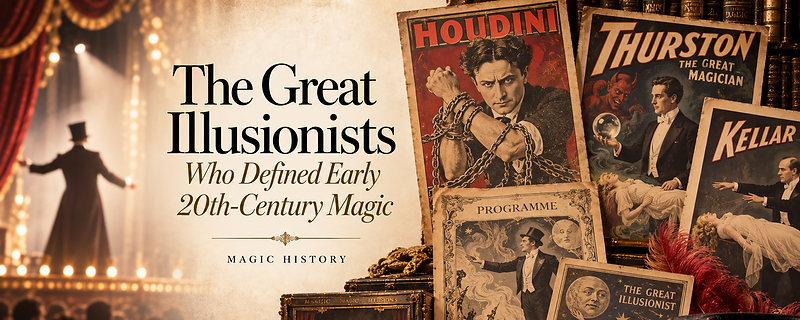
The Great Illusionists Who Defined Early 20th-Century Magic
The first decades of the twentieth century were an extraordinary period for stage magic. Full-evening illusion shows traveled with tons of scenery and apparatus, magicians became international celebrities, and performers competed to create spectacles audiences had never seen before. Harry Kellar, Adelaide Herrmann, Howard Thurston, Chung Ling Soo, Houdini, Blackstone, Dante, and others did more than perfect individual tricks. Together, they established many of the images, illusions, and traditions that still define stage magic.
By The Upchurch Collection of Magic
September 27, 2026

There was a period when the arrival of a magician could be treated almost like the arrival of a circus. Posters appeared throughout the city, newspapers announced challenges and impossible feats, and scenery, livestock, assistants, costumes, mechanical apparatus, and sometimes entire railroad cars of equipment traveled from theater to theater. The magician was not simply one entertainer on a variety bill. At the highest level, the magician could command an entire evening and build a theatrical world around himself. The early twentieth century inherited this tradition from nineteenth-century masters such as Jean Eugène Robert-Houdin and Alexander Herrmann,, but expanded it dramatically. Advances in transportation, printing, theater technology, electrical lighting, and mass advertising helped make possible touring productions of extraordinary complexity, while vaudeville and music halls created additional circuits on which specialty performers could become nationally and internationally known.
What emerged was not a single style of magic. Harry Kellar offered mysterious theatrical grandeur. Adelaide Herrmann combined illusion with visual elegance and choreography. Howard Thurston built one of America's great touring productions. Servais Le Roy helped redefine what a stage illusion could look like. Chung Ling Soo turned an invented identity into part of the illusion itself. Houdini transformed the escape challenge into mass entertainment. Harry Blackstone carried the traditional touring illusion show deep into the twentieth century, while Dante helped bring the era of enormous traveling magic productions toward its conclusion. These performers did not merely work during what is often called the Golden Age of Magic. They helped define what audiences came to believe a great magician was supposed to be.
Kellar, Herrmann, and the Inheritance of the Nineteenth Century
At the beginning of the twentieth century, Harry Kellar already represented the established order of American stage magic. Born Heinrich Keller in Pennsylvania in 1849, Kellar had spent decades traveling internationally before becoming one of the dominant illusionists in the United States. His importance was partly theatrical. His performances helped establish the image of the magician as master of an entire mysterious environment rather than merely a demonstrator of tricks. His posters surrounded him with devils, imps, spirits, and supernatural imagery, while his stage repertoire included large illusions, spirit effects, and his celebrated levitation. The audience understood that what it was seeing was theatrical deception, but the presentation deliberately borrowed the visual language of the impossible. Kellar's influence became especially clear in 1908, when he publicly transferred his position as America's leading illusionist to Howard Thurston, who was then promoted as “Kellar's successor.” The transition reflected the way magicians themselves thought about lineage: one great performer could symbolically pass the mantle to another.
The familiar history of this period can seem overwhelmingly male, but Adelaide Herrmann complicates that picture. For roughly twenty years she had been the principal stage partner of her husband, Alexander Herrmann, one of the great stars of nineteenth-century magic. When Alexander died suddenly in 1896, Adelaide did not simply retire the production. She continued performing, first preserving elements of the existing show and eventually building a career of her own that lasted for decades. Billed as the Queen of Magic, she performed illusions, manipulation, productions, vanishings, suspensions, and even the dangerous bullet catch. Her career demonstrated how misleading the term assistant could be. She had spent years learning the machinery, choreography, timing, and discipline required by a sophisticated touring illusion show before moving to the center of the stage herself. Her success also preserved an important truth about nineteenth-century theatrical magic: the secret method was only one part of the performance. Costume, movement, scenery, pacing, and visual composition mattered just as much.
Thurston and the Expansion of the Great Magic Show
If Kellar represented the established American master, Howard Thurston represented the full expansion of the great touring illusion show. Thurston had first become celebrated for card manipulation before developing increasingly ambitious stage productions. By the time Kellar publicly endorsed him as his successor in 1908, Thurston was positioned to inherit not only prestige but an audience that already understood the idea of the star magician. His productions became enormous entertainment enterprises involving assistants, animals, scenery, costumes, comedy, stage effects, and a constant succession of illusions. Thurston understood that a great magic show did not need to revolve around one extraordinary trick. The entire evening could feel impossible.
Just as importantly, Thurston understood that the performance began before the audience entered the theater. Posters, newspaper stories, advance publicity, and the reputation of the touring company all helped create expectation. The size of the show became part of the show. The magician's name itself became a promise. This is one reason the great illusionists of the period cannot be understood only by studying methods or apparatus. They were also running complicated entertainment businesses. They had to transport the production, fill theaters, maintain equipment, supervise assistants, develop new material, respond to competitors, and continually give audiences a reason to believe that the next season's show would be even more astonishing than the last.
Another important figure in this world was Servais Le Roy, whose influence came as much from invention and design as from personality. Le Roy performed with Mercedes Talma and Leon Bosco in the celebrated act Le Roy, Talma & Bosco, combining illusion, sleight of hand, and comedy. Talma was herself an accomplished coin manipulator, while Le Roy became associated with the development of several influential stage illusions. Among the most enduring was the Asrah levitation, in which a covered figure appears to rise from a couch, float into the air, and then vanish when the covering is removed. Variations of that image became a staple of stage magic for generations. Le Roy represents another side of the Golden Age illusionist: the performer as designer and engineer. Great magicians were not merely asking what trick they could perform. They were asking what impossible image the audience had never seen before, and then somebody had to figure out how to build it.
Chung Ling Soo, Lafayette, and the Power of Theatrical Identity
Few careers demonstrate the theatrical possibilities—and cultural complications—of the period better than Chung Ling Soo. The performer audiences knew by that name was actually William Ellsworth Robinson, an American magician born in New York in 1861. After years working in magic under other identities, Robinson created an elaborate Chinese persona around 1900, drawing heavily upon the presentation and reputation of the genuine Chinese magician Ching Ling Foo.. As Chung Ling Soo, Robinson dressed in stylized Chinese costume, altered his appearance, and maintained the fiction so thoroughly that he generally did not speak English publicly, using an interpreter as part of the presentation. The act made him enormously successful in Europe.
Seen from the twenty-first century, the racial impersonation and exotic stereotypes at the center of the character are impossible to ignore. They reflected a theatrical culture in which Western entertainers routinely turned other cultures into commercial spectacle. Preserving that history requires acknowledging both Robinson's success as an illusionist and the cultural assumptions that made the persona commercially possible. His career nevertheless reveals something fundamental about stage magic: the magician himself can become part of the illusion. Audiences were not merely being deceived by individual tricks. They were being presented with an invented identity maintained beyond the boundaries of any single effect. That illusion ended dramatically in 1918 when a malfunction during his bullet-catching act resulted in Robinson being genuinely shot. He died the following day. The tragedy became one of magic history's most famous stories, but it should not obscure what made Chung Ling Soo significant beforehand: Robinson had created one of the most successful theatrical personas in international magic.
The Great Lafayette,, born Sigmund Neuberger, demonstrated another direction entirely. His productions emphasized extravagance, spectacle, costume, animals, scenery, and an almost obsessive cultivation of personality. He became one of the highest-paid entertainers of his period and built shows intended to overwhelm audiences rather than simply puzzle them. His approach reflected the growing belief that the production itself could be astonishing. The magician no longer needed to be merely a manipulator of objects; he could be the center of an entire visual environment. Lafayette's career ended catastrophically in 1911 when a fire broke out during a performance at the Empire Palace Theatre in Edinburgh, killing Lafayette and members of his company. Today he is far less familiar to general audiences than Houdini or Thurston, despite his enormous success during his lifetime. That difference is itself instructive: fame during a lifetime does not guarantee historical memory.
Houdini Changes the Meaning of a Magic Star
Harry Houdini occupies a somewhat different position among the great performers of the era because his reputation was built less around the conventional full-evening illusion show than around escapes. That difference is exactly why he belongs in this history. Houdini transformed the image of the magician by making his own body the object of the effect. Handcuffs, jail cells, ropes, packing crates, bridges, water, and eventually the Water Torture Cell became the visual vocabulary of his career. Instead of standing safely beside an apparatus while someone else faced apparent danger, Houdini placed himself inside the danger.
His greatest innovation, however, was not the invention of escape magic. Escape effects existed before him. Houdini's genius was in combining escape with publicity. A local police department could supply the restraints. A newspaper could issue a challenge. A brewery could provide a sealed container. A theater engagement could be promoted through a public stunt before the audience ever purchased a ticket. The city itself became part of the performance. Magic was no longer confined to the stage. It could happen at a jail, on a bridge, in the street, or anywhere reporters and spectators could gather. In that sense, Houdini helped redefine what a star magician could be. He turned publicity into performance and performance into news.
That model would influence magicians long after his death. The dangerous television special, the public endurance stunt, the challenge escape, and the carefully engineered media event all carry traces of the system Houdini perfected. He demonstrated that an impossible event could become culturally significant not only because of what happened, but because the public had been prepared to care before it happened.
Sawing, Blackstone, and the Evolution of the Impossible Image
Not every revolutionary figure needed decades at the top of the profession. Sometimes one illusion could alter the direction of stage magic. In 1921, British magician P.T. Selbit presented the illusion generally recognized as the breakthrough public version of Sawing Through a Woman. His assistant was bound inside a large wooden box while the magician apparently cut through it. Within months, Horace Goldin was presenting a substantially different version in which the head and extremities remained visible, moving the effect closer to the image audiences still recognize today.
The competition surrounding sawing illustrates one of the most important patterns in the history of stage illusion. One magician creates an impossible image, another identifies where the audience thinks the explanation may be hiding, and then removes that hiding place. If the assistant is completely enclosed in a box, expose the head and feet. If the box seems suspicious, make it smaller. If even the smaller box seems too convenient, remove more of it. If the saw appears theatrical, make the blade larger and more threatening. Stage illusion repeatedly evolves by eliminating the explanations spectators believe they have found. Sawing became one of the defining visual symbols of twentieth-century magic because the danger required no explanation. The audience saw the saw and immediately understood the problem.
As vaudeville declined and entertainment technology changed, many enormous touring magic productions disappeared, but Harry Blackstone Sr. helped carry the tradition forward. Born in Chicago in 1885, Blackstone had grown up admiring the great illusionists who preceded him and eventually developed a major touring production with his brother Pete Bouton, whose technical work behind the scenes was essential to the show. Blackstone preserved many of the characteristics of the Golden Age production: a large company, elaborate apparatus, assistants, theatrical staging, and illusions capable of filling substantial theaters. His career also stretched into a changing entertainment world. He performed for military audiences during World War II and later appeared on television, becoming a bridge between the world of Kellar and Thurston and the emerging age of broadcast entertainment.
Dante and the End of the Great Touring Illusion Era
One of the final major representatives of the old touring tradition was Dante the Magician, born Harry August Jansen. Jansen had worked as a magician, builder, and magic dealer before becoming professionally connected with Howard Thurston. Thurston helped establish him under the Dante name, and Jansen eventually developed the character and production into an international career of his own. His shows became associated with the phrase “Sim Sala Bim” and combined illusion, comedy, theatrical spectacle, elaborate scenery, and the kind of large company that had characterized the great touring productions of the earlier era.
What They Left Behind
It is easy to reduce these performers to famous tricks: Kellar levitated a woman, Houdini escaped, Selbit sawed a woman in half, Blackstone presented grand illusions. The deeper history lies in how differently they imagined the job of being a magician. Kellar demonstrated how mystery, theatrical authority, and spectacle could be combined into the identity of the great magician. Adelaide Herrmann showed that the knowledge and showmanship necessary to command major illusion belonged to women as well as men. Thurston expanded the touring production into an enormous entertainment enterprise. Le Roy demonstrated the importance of the inventor and builder behind the visual miracle. Chung Ling Soo showed how completely theatrical identity itself could be manufactured, while leaving behind a complicated record of the racial attitudes embedded in popular entertainment. Lafayette pushed spectacle toward extravagance. Houdini moved magic into newspapers, police stations, bridges, streets, and public challenges. Selbit and Goldin created competing versions of an illusion whose visual language became almost synonymous with magic. Blackstone preserved the grand touring tradition into a new entertainment era, and Dante carried one of its last great versions around the world.
The differences between them are ultimately more revealing than their similarities. There was never one Golden Age style. There were competing answers to the same question: What should an audience believe a magician is capable of doing? Perhaps the most important development of the period was that the greatest performers became larger than any individual illusion. People did not merely buy tickets to see levitation; they bought tickets to see Thurston. They did not merely want to see an escape; they wanted to see Houdini escape. The magician's name could fill the poster before the audience knew what would be performed. Publicity, personality, costume, reputation, danger, mystery, and theatrical scale became part of the experience before the first trick began.
Modern magicians still work inside that inheritance. The enormous Las Vegas illusion production, the dangerous television special, the theatrical persona, the publicity stunt, the dramatic levitation, the buzz saw, the escape challenge, and even the idea of one magician symbolically succeeding another all carry traces of this period. The apparatus has changed, the theaters have changed, and the way audiences encounter celebrity has changed almost beyond recognition, but the image remains familiar: the lights come up, the magician appears, and the audience expects something impossible.
The great illusionists of the early twentieth century did not merely create tricks that survived them. They created expectations that magic is still trying to fulfill.
Continue Reading
Related Stories

Magic History
The Golden Age of Magic: When Magicians Became International Celebrities
From roughly the late nineteenth century through the early decades of the twentieth, magic entered an extraordinary period of theatrical ambition and public visibility. Railroads carried enormous illusion shows from city to city, color lithographs covered walls with impossible images, newspapers transformed publicity stunts into news, and performers such as Kellar, Thurston, Houdini, Chung Ling Soo, and Lafayette became celebrities whose names could sell a theater before audiences knew what they were going to see.
September 27, 2026


Magic History
How Jean-Eugène Robert-Houdin Helped Create Modern Stage Magic
Jean-Eugène Robert-Houdin is often called the father of modern magic, but his real importance is more interesting than the title suggests. He did not invent conjuring, theatrical magic, or even the elegant salon magician. What he did was bring together mechanics, science, theatrical design, natural presentation, and the persona of the gentleman performer in a way that profoundly influenced the magicians who followed him.
September 27, 2026

Magic History
Women in the History of Stage Magic
Women were never absent from stage magic. They were headliners, manipulators, mentalists, escape artists, assistants, television pioneers, and institutional leaders. The problem is that the historical record often placed them under someone else's name, inside someone else's act, or outside the story altogether.
September 27, 2026
Follow the Collection
Receive new Stories and collection updates
Receive new Stories, research, acquisitions, and collection updates by email.