
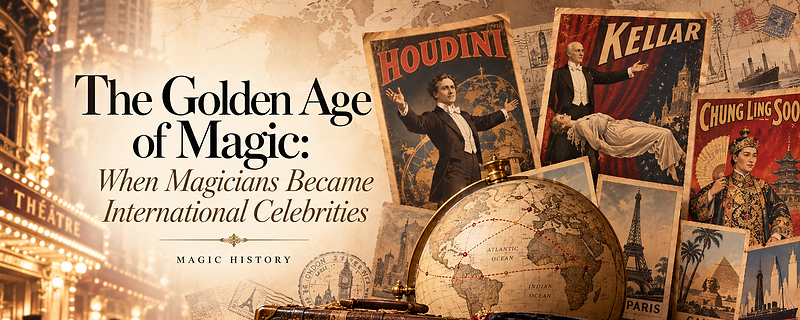
The Golden Age of Magic: When Magicians Became International Celebrities
From roughly the late nineteenth century through the early decades of the twentieth, magic entered an extraordinary period of theatrical ambition and public visibility. Railroads carried enormous illusion shows from city to city, color lithographs covered walls with impossible images, newspapers transformed publicity stunts into news, and performers such as Kellar, Thurston, Houdini, Chung Ling Soo, and Lafayette became celebrities whose names could sell a theater before audiences knew what they were going to see.
By The Upchurch Collection of Magic
September 27, 2026

The phrase Golden Age of Magic is generally used for the period surrounding the end of the nineteenth century and the first decades of the twentieth, although there is no single date on which it began or ended. The American Museum of Magic identifies performers such as Harry Kellar,, Howard Thurston,, Harry Houdini,, Maskelyne and Devant with the extraordinary commercial success of this period, when magic became firmly established in major theaters, vaudeville, and music halls. What made the era remarkable was not simply that several talented magicians happened to live at the same time. An entire entertainment system had developed that could turn a successful performer into a national or international celebrity. (Source: American Museum of Magic)
The technology surrounding the magician was changing almost as quickly as magic itself. Rail transportation made it possible to move performers, assistants, scenery, animals, and enormous quantities of apparatus between cities. Improvements in theatrical lighting and stage machinery allowed effects to become more visually ambitious. Color lithography could reproduce a magician's face and illusions on an enormous scale, while inexpensive newspapers carried reviews, advertisements, challenges, rumors, and publicity stories to audiences who might never have seen the performer in person. The Golden Age was therefore as much a product of modern communication and transportation as it was a product of ingenious methods. The great magicians learned how to use all of it.
When a Magician's Name Became the Attraction
Earlier conjurers had certainly achieved fame. Jean-Eugène Robert-Houdin had become internationally known in the nineteenth century, Alexander Herrmann had cultivated an immediately recognizable public image, and performers had toured across national borders long before 1900. During the Golden Age, however, the scale of celebrity became increasingly important to the business of magic. A successful performer did not simply advertise a particular trick. The performer's name became the product.
Harry Kellar illustrates the transition. By the turn of the twentieth century, Kellar had become one of the dominant figures in American theatrical magic. Posters sold not merely levitations or spirit effects but Kellar himself, often surrounded by supernatural imagery that made his face inseparable from the mysterious world of his show. When Kellar retired in 1908, Howard Thurston was publicly promoted as his successor. A surviving Strobridge lithograph preserved by the Library of Congress explicitly identifies Thurston as “Kellar's successor” and includes Kellar's endorsement of the younger magician. The advertisement was effectively announcing the transfer of magical celebrity from one star to another. (Source: Library of Congress)
Thurston subsequently built his own name into an enormous theatrical brand. Posters promised not simply a few clever tricks but “the world's famous magician” and a “Wonder Show.” His touring production eventually involved a large company and substantial equipment, demonstrating how far magic had moved from the image of a lone conjurer carrying a small case of apparatus. Audiences were buying entrance into an entire theatrical universe identified with one personality.
The Poster Became Part of the Celebrity
The visual culture of the Golden Age was impossible to separate from the performers themselves. The Library of Congress's Magic Poster Collection contains extensive material featuring Kellar, Thurston, Houdini, and other illusionists, much of it produced between the late nineteenth century and the early decades of the twentieth. These were not modest notices listing a performer's name and theater. They could be enormous, intensely colored advertisements filled with demons, skeletons, floating bodies, chains, spirits, severed heads, mysterious cabinets, and impossible transformations. (Source: Library of Congress)
The imagery created an identity before the performer arrived. Kellar could be associated with devils whispering secrets into his ear. Thurston could appear as the master of a universe filled with impossible phenomena. Houdini's advertisements increasingly centered on chains, restraints, police challenges, and physical danger. Chung Ling Soo sold an elaborate version of exotic mystery. The Great Lafayette projected extravagant theatrical grandeur. Each performer occupied a recognizable visual territory, and the poster taught audiences how they were supposed to understand the magician.
This was celebrity branding before anyone used that expression. A person walking past a wall of posters might recognize a magician without ever having attended the show. The lithograph carried the performer's image farther than the touring company itself could travel and helped turn faces, names, costumes, and slogans into commercial property.
Newspapers Made Magic Larger Than the Theater
Print journalism extended that reach even further. The most successful performers understood that newspaper coverage was more valuable than an ordinary advertisement because a publicity event could appear to be news. No magician exploited this more effectively than Harry Houdini. His escapes from police restraints, jail cells, bridges, packing crates, straitjackets, and water-filled containers could be staged outside the theater where thousands of people might see them without purchasing a ticket. The resulting photographs and newspaper stories then promoted the paid performance.
Houdini's genius was not merely escaping from difficult restraints. It was creating circumstances in which the public wanted to know whether he would escape. Smithsonian accounts of his career emphasize his relentless self-promotion and his ability to draw press coverage around public challenges. In 1914, for example, approximately 15,000 people reportedly watched one of his underwater box escapes in New York. Newspapers throughout the country later gave extensive coverage to his death in 1926, evidence of how far his fame had spread beyond the ordinary world of magic enthusiasts. (Source: Smithsonian Magazine)
Other magicians understood the same principle even if they used it differently. Rivalries could become publicity. Claims of theft or imitation could become publicity. Elaborate arrivals could become publicity. A dangerous illusion could become publicity before anyone saw it. The great magician was increasingly expected to exist in the public imagination between performances.
The trick might last five minutes.
The publicity surrounding it could last for months.
Magic Becomes International Entertainment
The Golden Age was also international in a way that deserves emphasis. Major performers did not merely tour several American cities or move between London and Paris. Successful companies crossed oceans. They appeared throughout Europe, North America, Australia, Asia, Africa, and other markets connected by expanding transportation networks and imperial trade routes. A magician's reputation could be created in one country, enhanced in another, and advertised in a third.
This international circulation affected the shows themselves. Performers carried illusions between continents, watched competitors, purchased apparatus abroad, and adapted presentations for different audiences. Ideas moved along the same routes. So did stereotypes. Golden Age magic often used imagery of an imagined “East,” supernatural traditions, ancient civilizations, and supposedly mysterious foreign cultures. Some performers adopted exotic stage identities because audiences associated distant places with secret knowledge and mystery. The enormous success of William Robinson performing as Chung Ling Soo, for example, depended partly on a Western theatrical culture willing to accept a manufactured Chinese persona as a form of entertainment.
That aspect of the period is important because the Golden Age was not simply an innocent world of beautiful posters and grand illusions. Its entertainment reflected the social assumptions of its time. Race, empire, gender, class, and ideas about “foreign” cultures shaped what audiences expected and what promoters believed they could sell. Preserving the history means preserving those uncomfortable elements alongside the mechanical ingenuity and theatrical beauty.
Competition Made the Illusions Bigger
Celebrity also created competition. When several internationally known magicians were touring simultaneously, each needed something the others did not have—or at least something that could be advertised as newer, larger, more dangerous, or more mysterious. That competitive pressure helped accelerate the development of spectacular stage illusion.
A successful illusion rarely remained untouched for long. One performer introduced an effect, another redesigned it, and a third found a way to eliminate the explanation audiences had begun to suspect. P.T. Selbit''s 1921 presentation of Sawing Through a Woman was rapidly followed by Horace Goldin''s competing version in which the head and feet remained visible. Similar cycles occurred throughout stage magic. Levitation systems evolved. Vanishes became larger. Apparatus became thinner or more deceptive. Public escapes became more dangerous. A magician who returned with exactly the same show year after year risked appearing outdated.
The business of touring therefore encouraged invention. Posters needed something new to advertise. Newspapers needed something new to describe. Audiences who had already seen last year's miracle needed another reason to purchase a ticket. The economics of celebrity helped push magical technology forward.
That did not mean every advertised innovation was truly new. Magicians have always borrowed, adapted, renamed, rediscovered, and occasionally claimed more originality than the historical record supports. But the appearance of novelty became crucial. To remain a great magician, it was increasingly necessary to look as if the impossible itself were progressing.
The Great Show Was Also a Business
Behind the romantic image of the Golden Age was an enormous amount of work. A large illusion production could require assistants, stage managers, mechanics, musicians, animal handlers, advance publicity workers, ticket sellers, costumers, carpenters, freight arrangements, hotel bookings, theater negotiations, and constant maintenance of apparatus that was being transported from city to city.
The headliner's name might dominate the poster, but no great touring production existed because of the headliner alone.
That reality is one reason surviving correspondence, programs, contracts, photographs, account books, and other ephemera are so important to the historical record. Posters preserve the fantasy. Business records reveal what was required to manufacture it. The grand illusion show was simultaneously a work of theater, a mechanical system, a traveling company, and a commercial enterprise.
Some performers proved particularly skilled at controlling all of those elements. Thurston's show grew into a major touring operation. The Great Lafayette surrounded himself with elaborate scenery, costumes, animals, and personnel. Harry Blackstone Sr. later carried much of the touring illusion tradition forward with the crucial technical involvement of his brother Pete Bouton. Dante continued the large revue format internationally even as the entertainment economy that created it began to fade.
The magician standing under the spotlight was therefore only the visible center of a much larger machine.
Why the Golden Age Ended
There was no single night when the Golden Age of Magic ended. Its decline was gradual because the entertainment world around it was changing.
Vaudeville weakened. Motion pictures offered spectacular visual entertainment without requiring a huge touring company to arrive in town. Radio entered millions of homes. Theater economics changed, and transporting large companies became increasingly expensive. By the middle of the twentieth century, television would begin offering magicians access to audiences that even the greatest touring illusionists could never physically reach.
Some traditions survived. Blackstone continued performing large illusion shows. Dante toured internationally. Nightclubs, circuses, theaters, and later Las Vegas provided new homes for stage magic. Television created another kind of magical celebrity altogether. The art did not disappear when the Golden Age ended; its economic center simply moved.
The strange result is that later generations often remember the Golden Age primarily through what it left behind: magnificent lithographs, photographs of elaborate apparatus, programs from vanished theaters, newspaper clippings, postcards, letters, and the reputations of performers whose actual shows can no longer be experienced.
That absence makes the surviving material more important.
When Magic Became Part of Popular Culture
The greatest legacy of the Golden Age may be that magic became recognizable mass culture.
Houdini became so famous that his name eventually entered ordinary language as a synonym for escape. Kellar and Thurston created images of the theatrical magician that survived long after their shows disappeared. Sawing a woman in half became recognizable even to people who had never seen the original performers. The tailcoat, mysterious cabinet, levitating assistant, chains, spirit imagery, and dramatic stage apparatus became cultural shorthand for magic itself.
More importantly, the era established a model of magical celebrity that never completely disappeared. David Copperfield''s television specials, Siegfried & Roy''s enormous Las Vegas productions, David Blaine''s public endurance events, and the branding of modern illusionists all belong to a tradition in which audiences are asked to care not only about what impossible thing will happen but who is going to make it happen.
That distinction was one of the defining achievements of the Golden Age.
Before the first curtain rose, the audience already knew the magician's name. They had seen the poster, read the newspaper story, heard about the challenge, or watched the advertisements appear around town. By the time the performer stepped onto the stage, an image had already been created in the spectator's mind.
The great magicians understood that the illusion began there.
The Golden Age of Magic was not simply the period when stage illusions became larger. It was the period when the magicians themselves became larger than life.
Continue Reading
Related Stories


Magic History
How Jean-Eugène Robert-Houdin Helped Create Modern Stage Magic
Jean-Eugène Robert-Houdin is often called the father of modern magic, but his real importance is more interesting than the title suggests. He did not invent conjuring, theatrical magic, or even the elegant salon magician. What he did was bring together mechanics, science, theatrical design, natural presentation, and the persona of the gentleman performer in a way that profoundly influenced the magicians who followed him.
September 27, 2026

Magic History
The Great Illusionists Who Defined Early 20th-Century Magic
The first decades of the twentieth century were an extraordinary period for stage magic. Full-evening illusion shows traveled with tons of scenery and apparatus, magicians became international celebrities, and performers competed to create spectacles audiences had never seen before. Harry Kellar, Adelaide Herrmann, Howard Thurston, Chung Ling Soo, Houdini, Blackstone, Dante, and others did more than perfect individual tricks. Together, they established many of the images, illusions, and traditions that still define stage magic.
September 27, 2026

Magic History
Women in the History of Stage Magic
Women were never absent from stage magic. They were headliners, manipulators, mentalists, escape artists, assistants, television pioneers, and institutional leaders. The problem is that the historical record often placed them under someone else's name, inside someone else's act, or outside the story altogether.
September 27, 2026
Follow the Collection
Receive new Stories and collection updates
Receive new Stories, research, acquisitions, and collection updates by email.