
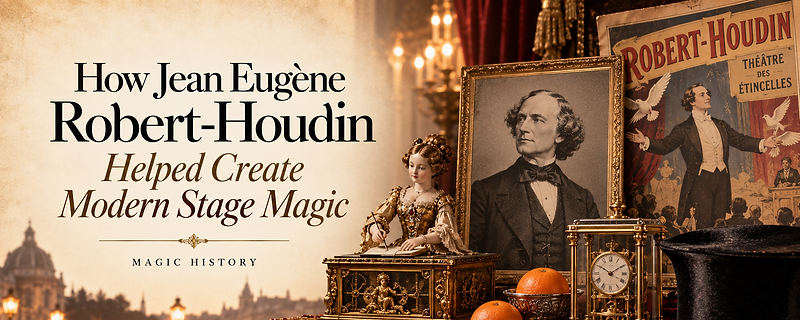
How Jean-Eugène Robert-Houdin Helped Create Modern Stage Magic
Jean-Eugène Robert-Houdin is often called the father of modern magic, but his real importance is more interesting than the title suggests. He did not invent conjuring, theatrical magic, or even the elegant salon magician. What he did was bring together mechanics, science, theatrical design, natural presentation, and the persona of the gentleman performer in a way that profoundly influenced the magicians who followed him.
By The Upchurch Collection of Magic
September 27, 2026

Few names have cast a longer shadow over the history of conjuring than Jean-Eugène Robert-Houdin.. Nearly every history of modern magic eventually describes him as the “father of modern magic,” a phrase useful enough to have survived for generations but simple enough to be misleading. Magic did not suddenly become modern when Robert-Houdin walked onto a Paris stage. Professional conjurers, elaborate mechanical apparatus, theatrical magic, magic dealers, salon performers, and sophisticated illusionists all existed before him. Performers such as Pinetti and Comte had already presented magic before fashionable European audiences, and specialized manufacturers were producing conjuring apparatus in Paris before Robert-Houdin established his theater. What Robert-Houdin accomplished was not the invention of modern magic from nothing. He helped consolidate a new idea of what a professional magician could be.
His magic belonged conspicuously to the nineteenth century around him. Machinery, electricity, optics, scientific demonstration, automata, fashionable dress, bourgeois interiors, and theatrical engineering all became part of his vocabulary. Rather than asking audiences to imagine that he possessed ancient occult knowledge, Robert-Houdin could present impossibility as something emerging from the same modern world that was already transforming their lives. The magician became an elegant, educated host presiding over an environment in which everyday objects behaved impossibly and machines appeared almost alive. That combination proved enormously influential. Cirque CNAC)
From Watchmaker to Magician
Robert-Houdin was born Jean-Eugène Robert in Blois, France, in 1805. His background in clockmaking and mechanics was not incidental to his later career; it was one of the foundations of it. He developed expertise in precision machinery, constructed clocks and automata, and patented mechanical and electrical inventions. After marrying Cécile Houdin, whose father was also a clockmaker, he adopted the combined surname by which history remembers him. During the 1830s and early 1840s, he devoted much of his attention to horology, mechanical invention, and automata before committing himself fully to professional magic. (Source: Maison de la Magie)
That background shaped the kind of magician he became. Many of his celebrated effects depended upon an understanding of mechanics, hidden systems, timing, and the possibilities of new technology. His mysterious clocks appeared to operate without visible mechanisms. His automata wrote, drew, performed acrobatics, or imitated human activity. His stage effects transformed those same principles into theater. The boundary between scientific invention and magical apparatus could be remarkably thin: a mechanism might be interesting as engineering in one setting and astonishing as illusion in another.
This helps explain why Robert-Houdin's contribution cannot be reduced to sleight of hand. His importance came partly from treating magic as a designed environment. Apparatus, furniture, architecture, lighting, concealed mechanisms, presentation, and the performer's behavior could all work together. The illusion did not begin with the secret device. It began with the world the magician created around it.
A Theater Built for Magic
In 1845, Robert-Houdin opened his own theater near the Palais-Royal in Paris and began presenting his celebrated Soirées Fantastiques. The venue was deliberately designed for magic. Hidden openings, concealed access, architectural features, stage machinery, and carefully arranged sightlines could assist effects without appearing to the audience as obvious magical apparatus. Rather than bringing a collection of tricks onto an ordinary stage, Robert-Houdin had created a room in which the stage itself could participate in the deception. (Source: Cirque CNAC)
The atmosphere was equally important. Robert-Houdin appeared in fashionable evening dress rather than presenting himself as an exotic sorcerer surrounded by robes and magical symbolism. The setting evoked an elegant drawing room. Ordinary-looking furniture and familiar objects could suddenly become impossible. The magician appeared less like a supernatural being than a cultivated gentleman inviting guests to witness extraordinary experiments. The contrast made the effects stronger. If everything onstage looked strange, the audience expected strange things to happen. If the setting looked refined and recognizable, an impossible event could feel like a rupture in normal life.
This image of the gentleman magician became one of Robert-Houdin's most enduring contributions. It should not be mistaken for something he invented single-handedly; salon magic and socially respectable conjuring already existed. What he did particularly well was turn those traditions into a coherent theatrical identity and then spread that identity through successful performances, international appearances, and his later books. The tailcoat, polished manners, conversational presentation, and apparently ordinary surroundings became part of a model that generations of professional magicians would recognize. (Source: Maison de la Magie)
Machines That Seemed to Think
Robert-Houdin's stage repertoire reflected his fascination with the scientific and technological world around him. His Marvelous Orange Tree apparently blossomed and produced fruit before the audience, ultimately revealing an object in a theatrical mechanical climax. His Second Sight routine used apparent thought reading between Robert-Houdin and his son. His Ethereal Suspension drew upon contemporary public fascination with ether and presented the impossible suspension of a human body using the language of modern science. His automata similarly blurred the distinction between machine and living performer. (Source: Maison de la Magie)
That use of contemporary science was more than decoration. Robert-Houdin understood that the magician's presentation could exploit whatever the audience currently found mysterious. Electricity, magnetism, anesthesia, mechanical automation, and optics belonged to a world in which genuine technological developments already seemed extraordinary. The magician could place a fictional explanation beside a real scientific discovery and allow the audience's uncertainty to do part of the work.
One of his famous effects, the Light and Heavy Chest, captures the idea particularly well. A small chest could initially be lifted, but after Robert-Houdin supposedly removed a spectator's strength, the same chest became impossible to raise. An electromagnetic mechanism could secure it to the floor. The secret depended upon modern technology, but the theatrical effect depended upon something older: the magician appeared capable of controlling another person's physical power. Robert-Houdin's great strength was often found in that intersection. Machinery supplied the method; theater supplied the miracle.
When Magic Became an Instrument of Empire
One episode in Robert-Houdin's career also demonstrates that magic could serve purposes far beyond entertainment. In 1856, after largely retiring from regular performance, he traveled to French-controlled Algeria at the request of colonial authorities. French officials were concerned about the influence of Muslim religious figures commonly described by the French as marabouts, some of whom were associated with extraordinary demonstrations interpreted by observers as supernatural abilities. Robert-Houdin was brought in to perform before Algerian audiences in an effort to demonstrate that apparently miraculous feats could be surpassed by French theatrical and technological skill. (Source: DOI)
The Light and Heavy Chest became particularly useful in this setting. Robert-Houdin reframed the effect so that he appeared able to remove a man's strength. In his own memoirs, he described the Algerian performances as having a political purpose and took pride in the idea that a conjurer could render service to France. Modern scholarship treats the episode more critically. It was not simply a charming story about a magician defeating superstition with science; it was also an act of colonial theater, deliberately staged within a struggle for political authority. French power, technological modernity, religious belief, and the supposedly superior knowledge of the colonizer were all being dramatized through an illusion show. (Source: Cambridge University Press)
That uncomfortable history deserves to remain part of Robert-Houdin's story. His career demonstrates the cultural power that magic could acquire precisely because audiences were not always certain where theatrical deception ended and extraordinary knowledge began. The same ambiguity that made an illusion compelling on a Paris stage could be deliberately weaponized when transplanted into a colonial setting.
Robert-Houdin Wrote Magic Down
Robert-Houdin's influence also survived because he wrote about the art. His memoirs and instructional works helped preserve not merely particular tricks but an entire way of thinking about performance. He discussed sleight of hand, apparatus, presentation, psychology, misdirection, mechanical principles, and the behavior expected of the magician. Later generations could study him without ever having seen him perform.
This mattered enormously. Performance traditions can disappear when knowledge exists only between living practitioners. A book allows techniques, arguments, terminology, stories, and professional values to cross generations. Robert-Houdin's writings became part of the literature through which magicians learned how earlier practitioners thought about their craft. The Bibliothèque nationale de France continues to preserve his works, while the Maison de la Magie in his native Blois preserves objects and historical material associated with both his magical and scientific careers. (Source: Bibliothèque nationale de France)
His memoirs must nevertheless be read like other autobiographical sources: as both historical evidence and self-presentation. Even the Maison de la Magie cautions that Robert-Houdin was conscious of having lived an extraordinary life and that portions of his autobiographical storytelling may have been romanticized. That makes his writings more interesting rather than useless. The magician who had carefully controlled what audiences saw onstage also understood how to shape the story of his own career. Maison de la Magie)
Houdini, Robert-Houdin, and the Problem of Great-Man History
Robert-Houdin's reputation became so powerful that, decades after his death, a young performer named Ehrich Weiss adopted the name Harry Houdini in tribute to him. Houdini initially regarded the French magician as a hero. Later, however, the relationship became much stranger. In 1908 Houdini published The Unmasking of Robert-Houdin, an aggressive attempt to demonstrate that Robert-Houdin had received credit for inventions and accomplishments that properly belonged to earlier magicians. The Library of Congress describes the book as an attack upon Houdini's former hero. (Source: PBS)
Houdini's criticism was sometimes excessive, but the underlying historical question is useful. Calling Robert-Houdin the “father of modern magic” can unintentionally make the history before him disappear. Earlier conjurers had already performed before elite audiences. Mechanical magic was already sophisticated. Dedicated theaters and magic suppliers existed. Many effects associated with famous performers evolved from earlier ideas rather than appearing fully formed in the mind of one inventor.
Robert-Houdin does not become less important when that mythology is removed.
He becomes more interesting.
His achievement was not that no one before him had ever worn formal clothing, used machinery, performed in a theater, or entertained sophisticated audiences. His achievement was the unusually successful combination of those things. He helped establish a model of professional magic that appeared intellectually modern, mechanically ingenious, theatrically refined, and socially respectable.
A Direct Line From Magic to Cinema
Robert-Houdin's influence even extended into an art form that did not yet exist when he created his theater. After several changes of ownership, the Théâtre Robert-Houdin was purchased in 1888 by Georges Méliès, himself a magician before becoming one of the great pioneers of early cinema. Méliès incorporated theatrical illusion, substitution, disappearance, transformation, mechanical effects, and magical imagery into filmmaking. The history of the theater therefore creates an extraordinary bridge between nineteenth-century conjuring and the development of cinematic special effects. (Source: Cirque CNAC)
That connection is almost too appropriate. Robert-Houdin had spent his career using machinery and controlled perception to make audiences question what they were seeing. Méliès would soon do something similar with film.
The medium changed.
The principle did not.
What Robert-Houdin Actually Made Modern
If Robert-Houdin helped create modern stage magic, it was not because he drew a line separating everything primitive before him from everything sophisticated afterward. History rarely changes that cleanly. His importance lies in synthesis. He brought together precision mechanics, automata, scientific ideas, elegant theatrical presentation, purpose-built staging, natural-looking objects, written theory, and the persona of the gentleman magician at a moment when European society was fascinated by technological progress.
He also understood something that remains central to great magic: the secret is not the performance.
A hidden mechanism can explain why a chest cannot be lifted. It cannot explain why the audience remembers a magician apparently stealing a man's strength. Machinery can explain how an automaton moves. It cannot explain why the machine seems momentarily alive. A concealed stage device may account for an appearance or disappearance, but the apparatus alone does not create wonder.
That required theater.
Robert-Houdin's greatest legacy may therefore be less a particular illusion than a professional philosophy visible throughout his career: magic should not merely hide a mechanism. It should construct a believable world in which the impossible seems to happen naturally.
Nearly two centuries after the Soirées Fantastiques, that remains one of the central problems every magician is still trying to solve.
Continue Reading
Related Stories


Magic History
The Golden Age of Magic: When Magicians Became International Celebrities
From roughly the late nineteenth century through the early decades of the twentieth, magic entered an extraordinary period of theatrical ambition and public visibility. Railroads carried enormous illusion shows from city to city, color lithographs covered walls with impossible images, newspapers transformed publicity stunts into news, and performers such as Kellar, Thurston, Houdini, Chung Ling Soo, and Lafayette became celebrities whose names could sell a theater before audiences knew what they were going to see.
September 27, 2026

Magic History
The Great Illusionists Who Defined Early 20th-Century Magic
The first decades of the twentieth century were an extraordinary period for stage magic. Full-evening illusion shows traveled with tons of scenery and apparatus, magicians became international celebrities, and performers competed to create spectacles audiences had never seen before. Harry Kellar, Adelaide Herrmann, Howard Thurston, Chung Ling Soo, Houdini, Blackstone, Dante, and others did more than perfect individual tricks. Together, they established many of the images, illusions, and traditions that still define stage magic.
September 27, 2026

Magic History
Women in the History of Stage Magic
Women were never absent from stage magic. They were headliners, manipulators, mentalists, escape artists, assistants, television pioneers, and institutional leaders. The problem is that the historical record often placed them under someone else's name, inside someone else's act, or outside the story altogether.
September 27, 2026
Follow the Collection
Receive new Stories and collection updates
Receive new Stories, research, acquisitions, and collection updates by email.