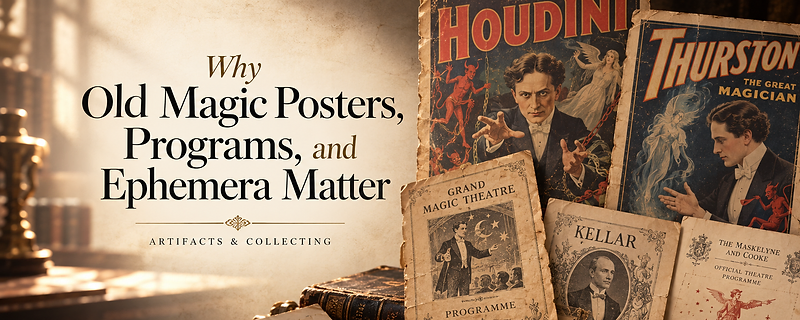
Why Old Magic Posters, Programs, and Ephemera Matter
Magic ephemera was created to be temporary. Posters were pasted to walls, programs were folded into pockets, tickets were torn at theater doors, and handbills were discarded once the show left town. Precisely because these objects were never expected to become history, the examples that survive can reveal details about performers, theaters, touring routes, illusions, audiences, and careers that more formal histories often miss.
By The Upchurch Collection of Magic
September 27, 2026

A spectacular illusion may be remembered for generations, but the performance itself disappears almost immediately. The curtain falls, the apparatus is packed, the company moves to another city, and eventually even the people who witnessed the show are gone. Much of what allows us to reconstruct the history of magic comes from the material left around the performance rather than the performance itself: posters, programs, handbills, tickets, window cards, advertising sheets, dealer catalogs, postcards, photographs, newspaper clippings, letterheads, and countless other pieces of paper that were designed for immediate use and then expected to be thrown away.
The Library of Congress defines ephemera as printed material created for a limited purpose and ordinarily discarded after use. Its own collections include such things as ticket stubs, brochures, flyers, invitations, programs, menus, posters, and other documents that survived despite their temporary purpose. Historians value these objects precisely because they were produced while events were happening. They often record details that no one thought important enough to preserve in a formal history. (Source: Library of Congress — Printed Ephemera Collection.)
For magic historians, that makes ephemera unusually important. A book tells us what someone wanted to publish. A biography tells us how a life was later remembered. A poster, program, or ticket can tell us what was actually being advertised, where it happened, when it happened, what the performer called the act, and sometimes who else was standing on the stage.
The Things Nobody Expected to Survive
The word ephemera can make these objects sound insignificant. Historically, their lack of permanence is exactly what makes them valuable.
A theater program might have been printed by the thousands for a week's performances. Once the engagement ended, there was little reason for anyone to save it. A handbill announcing a magician's arrival had completed its purpose as soon as the show was over. A ticket stub was proof that someone had been admitted to a theater and nothing more. Posters were pasted outdoors, displayed in shop windows, folded, rolled, covered by later advertisements, damaged by weather, or simply destroyed when a touring company no longer needed them.
Most were not collectibles when they were new.
That is one reason the survivors can become so informative. The Library of Congress notes that printed ephemera provides unusually immediate snapshots of the periods that produced it because such material was created for contemporary use rather than for future historians. A surviving advertisement may preserve prices, language, imagery, addresses, names, and social assumptions that would otherwise have vanished. (Source: Library of Congress — About the Printed Ephemera Collection.)
Magic magnifies that problem because it is already an ephemeral art. The trick disappears when it is finished. The paper surrounding the trick may be all that remains.
A Poster Can Establish More Than What the Show Looked Like
Magic posters deserve attention as art, but their historical usefulness goes much further than their visual beauty. A poster can establish a performer in a particular city, identify the name under which an illusion was being promoted, reveal how an act was positioned against competitors, or document a stage in a magician's career that later became overshadowed by something more famous.
Consider the familiar image of Harry Houdini as the great escape artist. One surviving Library of Congress poster presents a much earlier identity: "Harry Houdini, King of Cards." The poster dates to approximately 1895, before handcuffs, jail escapes, bridge jumps, and underwater feats had become the foundation of the Houdini legend. It is physical evidence of an earlier professional identity and a reminder that famous careers did not begin in their final form. (Source: Library of Congress — Harry Houdini, King of Cards.)
Another Houdini poster advertises his appearance at Liverpool's Empire Theatre and incorporates a testimonial from the city's head constable dated February 2, 1904, certifying Houdini's ability to escape from restraint. That single sheet does several jobs at once. It documents a venue, a date, a city, a publicity strategy, and Houdini's deliberate use of police authority to make his challenges appear credible. (Source: Library of Congress — Houdini Appears at the Empire Theatre)
Howard Thurston''s posters tell another kind of story. A 1908 Strobridge lithograph advertised Thurston as "Kellar's successor" and even incorporated Harry Kellar''s endorsement that Thurston would become the world's greatest magician. The object is therefore more than an attractive advertisement. It records the marketing of a professional succession from one major illusionist to another. (Source: Library of Congress — Thurston, Kellar's Successor.) Those are the kinds of details ephemera can preserve almost accidentally.
Programs Reconstruct the Show That Disappeared
Posters tell audiences to come. Programs tell historians more about what happened after they arrived.
A surviving program can preserve the order of a performance, the names of supporting performers, individual illusion titles, musical selections, specialty acts, sponsors, advertisements, theater management, and other details that rarely appear in later biographies. Comparing programs from several years can reveal when an illusion entered an act, when it disappeared, or how a production changed as a magician moved between theaters and markets.
This matters because theatrical productions were rarely static. A magician might retain the same public identity for years while continually changing the show behind it. Acts grew, contracted, changed assistants, introduced new apparatus, retired old material, and altered presentation to fit new venues. A single program provides a snapshot. A sequence of programs can become a chronology.
Harvard's Houghton Library preserves a collection of magic-related playbills and posters dating from 1800 to 1936 that also contains programs, advertisements, periodicals, postcards, clippings, lithographic portraits, and other material. The collection encompasses not only magicians but ventriloquists, illusionists, mesmerists, jugglers, and related entertainers. The breadth of the archive illustrates something fundamental about historical research: reconstructing a performance culture usually requires many kinds of documents rather than one spectacular object. (Source: Harvard Library — Playbills and Posters Concerning Magic, 1800–1936 HOLLIS Archives.)
A program folded into someone's coat pocket can eventually tell us more about the actual structure of a vanished show than a pristine advertising poster ever could.
Ephemera Can Recover the People Around the Famous Name
There is another reason this material matters: posters and programs can preserve people whom later histories forgot.
Magic history naturally accumulates around major names. Houdini, Kellar, Thurston, Blackstone,, Dante,, and other headliners generated enormous amounts of publicity and have been researched repeatedly. But every major touring production involved other people: assistants, partners, musicians, managers, stagehands, specialty performers, illusion builders, advance agents, theater employees, and local participants.
Their names may survive only in the smaller material.
A program might identify an assistant whom the larger poster simply depicts without naming. A handbill can document an obscure performer who never became nationally famous. A local advertisement may establish that a regional magician was working decades earlier than family memory suggests. A photograph with a handwritten inscription can reconnect a face with a name. An envelope can provide an address. Dealer stationery may help trace the movement of apparatus from maker to performer.
This is one of the reasons seemingly minor pieces deserve careful cataloging. The glamorous object attracts attention, but the ordinary object frequently supplies context.
The American Museum of Magic provides an extraordinary example of the scale this material can reach. The collection assembled by Robert and Elaine Lund ultimately included more than 12,000 books, approximately 3,000 posters, letters, diaries, photographs, scrapbooks, periodicals, costumes, apparatus, and an estimated 350,000 pieces of ephemera. That enormous body of paper is not incidental to the museum's historical value. It is one of the things that makes serious research possible. (Source: American Museum of Magic — Our History.)
The Advertisement Is Evidence, but It Is Not Always the Truth
Historical ephemera also has to be read carefully.
A magic poster was an advertisement. Its purpose was not to provide an objective technical record of what happened onstage. The magician might be depicted larger, younger, more elegant, more mysterious, or more powerful than reality. Devils, spirits, lightning, floating figures, skeletons, impossible machinery, and enormous crowds could communicate atmosphere without literally depicting the performance.
That exaggeration does not make the poster bad evidence. It tells us something different.
It tells us how the performer wanted to be understood.
A 1914 Strobridge poster for Howard Thurston, for example, surrounds the magician with supernatural imagery and promotes his production as "The Wonder Show of the Universe." Later Thurston posters produced by the Otis Lithograph Company continued to use ghosts, demons, and other imagery associated with mystery and the supernatural. Those images should not be interpreted as literal diagrams of Thurston's stage apparatus. They are evidence of branding—the visual language used to sell magic to contemporary audiences. (Source: Library of Congress — Thurston the Great Magician: The Wonder Show of the Universe.)
That distinction is important for collectors and historians. Ephemera records history, but it records history through the purposes of the people who created it. A newspaper advertisement wants to sell seats. A dealer catalog wants to sell tricks. A publicity photograph wants to create a persona. A theater program may flatter its stars.
The historian's job is not merely to preserve the paper. It is to understand what the paper was trying to do.
Collections Turn Scraps of Paper Into Evidence
One piece of ephemera may answer a question. Thousands of pieces can reveal patterns.
The Library of Congress's McManus-Young Collection demonstrates what happens when collectors preserve material at scale. John and Hanna McManus and Morris and Chesley Young assembled more than 20,000 items that were eventually given to the Library of Congress in 1955. The collection includes extensive material on figures such as Houdini, Blackstone, Dante, Thurston, Hardeen,, and others, along with material dealing with conjuring, spiritualism, ventriloquism, gambling, hypnosis, and related subjects. (Source: Library of Congress — McManus-Young Collection. Finding Aids)
The individual pieces matter. Their relationship to one another matters even more.
A poster might advertise a performance. A clipping might review it. A program might identify what was performed. A letter might explain a problem that occurred during the engagement. A later advertisement might show that an illusion had been renamed. A photograph could reveal how the apparatus actually looked. Together, those materials begin to reconstruct an event that no recording captured.
That is when collecting becomes an archive.
Condition Is Not the Same as Historical Importance
Collectors naturally care about condition. A bright, unfolded poster with strong color is usually more attractive than one with tears, tape, staining, or missing corners. But historical significance and physical perfection are not the same thing.
A program containing handwritten notes may be more informative than an untouched example. A poster with a theater stamp may establish where it was actually used. A ticket with a date, seat number, or price can provide evidence unavailable from a generic souvenir. Pinholes can demonstrate that a poster was displayed. A fold may tell us how material was transported.
Damage should not automatically be romanticized; deterioration can eventually destroy information. But preservation should distinguish between destructive decay and evidence of use.
Sometimes wear is part of the provenance.
That principle is particularly important with ephemera because these objects were never designed for archival survival. Their fragility is part of their history.
The Famous Poster and the Five-Dollar Handbill
One of the easiest mistakes in building a historical collection is to equate monetary value with historical value.
A great lithographic Houdini or Kellar poster may be visually spectacular, culturally important, and financially valuable. It can anchor an exhibition. But a modest handbill for an obscure regional magician may be the only surviving documentation of that performer. A ticket stub from a famous show might establish the date of an encounter. A small promotional photograph may carry an inscription that explains where it came from. A mimeographed club program might identify performers whose careers were never otherwise documented.
The expensive object and the inexpensive object answer different historical questions.
This is why a serious collection should not consist only of trophies. The best-known performers deserve representation, but the material surrounding ordinary performances can reveal how magic actually functioned as a profession and as a part of community life.
There is history in the grand theater.
There is also history in the county fair, the hotel ballroom, the magic club, the school auditorium, the church fellowship hall, the television studio, the convention room, and the local theater that disappeared fifty years ago.
Ephemera is often what proves that any of it happened.
Preserving What Was Designed to Disappear
The paradox of ephemera is that its original disposability is what gives surviving examples so much of their historical power.
A program was not created because someone expected a museum to display it a century later. A ticket was not printed for a historian. A magician's promotional postcard was not intended to become a primary source. These objects survived because somebody put them in a scrapbook, tucked them into a book, carried them home from a theater, stored them in a box, or eventually recognized that something temporary had become evidence.
For The Upchurch Collection of Magic, this is why posters, programs, flyers, tickets, advertisements, correspondence, photographs, and other paper material belong beside apparatus and performance-used objects. They provide dates, places, relationships, imagery, language, and context. Sometimes they establish provenance for another object. Sometimes they document a famous career. Sometimes they are all that remains of one that was almost forgotten.
A prop can show us what a magician used.
A poster can show us what the audience was promised.
A program can show us what the audience was given.
A ticket can show us that someone was there.
And a hundred years later, a piece of paper that was supposed to last one evening may be the reason we can still tell the story at all.
Continue Reading
Related Stories

Artifacts & Collecting
Why Autographs and Personal Correspondence Matter in a Magic Collection
An autograph can establish a direct connection to a performer, but a letter can do something even more important: it can preserve the performer's voice. In a field built around public personas, secrecy, collaboration, and constant reinvention, signed photographs, inscriptions, letters, notes, and correspondence can reveal the human relationships and working history that posters and props alone cannot.
September 27, 2026

Artifacts & Collecting
Why Magicians Collect the History of Their Own Art
Magicians have an unusually long tradition of becoming historians of their own art. They save books, apparatus, photographs, posters, letters, programs, manuscripts, and even seemingly insignificant scraps of paper because they understand how quickly a performance can disappear. From Harry Houdini and Robert Lund to Ricky Jay and David Copperfield, some of the people most determined to preserve magic have been magicians themselves.
September 27, 2026
Follow the Collection
Receive new Stories and collection updates
Receive new Stories, research, acquisitions, and collection updates by email.