
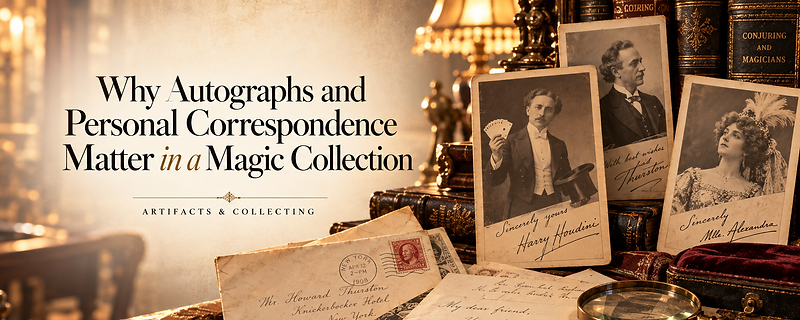
Why Autographs and Personal Correspondence Matter in a Magic Collection
An autograph can establish a direct connection to a performer, but a letter can do something even more important: it can preserve the performer's voice. In a field built around public personas, secrecy, collaboration, and constant reinvention, signed photographs, inscriptions, letters, notes, and correspondence can reveal the human relationships and working history that posters and props alone cannot.
By The Upchurch Collection of Magic
September 27, 2026
A magician's public image is carefully constructed. The audience sees the costume, the stage name, the publicity photograph, the impossible effect, and the confidence required to make uncertainty look effortless. What the audience usually does not see is everything surrounding the performance: negotiations with theaters, discussions with builders, arguments over credit, letters to other magicians, notes about new material, requests for advice, congratulations after a successful show, complaints about a difficult engagement, and the ordinary correspondence of a person trying to make a living from an unusual profession.
That is what makes autographs and personal correspondence so valuable in a magic collection. They bring the performer out from behind the poster.
A signed photograph can connect an object directly to an individual. An inscribed book can document a relationship between two people. A letter can establish where a magician was working, what he or she was thinking about, who they knew, what they were building, or what problems they were trying to solve. Sometimes a few handwritten lines contain information that never appeared in a published biography.
The signature is important.
The context around it can be even more important.
An Autograph Is More Than a Name
Autographs are often treated as collectibles first. A famous signature is desirable because the person who made it was famous, and scarcity, condition, presentation, and authentication naturally affect its value. But within a historical collection, the significance of a signature goes beyond celebrity.
A genuine autograph establishes physical contact between a person and an object.
The performer held the photograph. The magician opened the book. Someone placed the program in front of them. A pen moved across the page in their hand. That direct connection is one reason signed material can have an immediacy that reproductions cannot duplicate.
But not every autograph carries the same amount of historical information.
A signature written on a blank card identifies the signer. A signed publicity photograph also preserves the image under which that person promoted himself or herself at a particular stage of a career. An inscribed photograph may identify the recipient. A signed program links the performer to a specific production. A book presented by one magician to another can document a professional friendship. A handwritten letter contains the signature, but also preserves language, personality, relationships, and information.
The autograph becomes more valuable historically as the surrounding context becomes stronger.
The Difference Between an Autograph and a Story
Consider two signed photographs of the same magician.
One was purchased decades later from an autograph dealer with no known history beyond the signature. The other was mailed by the magician directly to a fan after an exchange of correspondence and remains with the original envelope and letter.
Both may be genuine.
But they do not tell the same story.
The second object has a chain of events attached to it. We know why it was signed, who received it, approximately when it entered the world, and how it moved from the performer to the recipient. If the envelope retains a postmark, even the date and location may be independently documented.
That history is provenance.
The same principle applies when a signed object is obtained directly after a performance. The autograph itself matters, but so does the ticket, photograph, program, date, venue, and recollection of the encounter. Preserved together, those pieces transform a signature into documentation of an event.
For a museum or historical collection, that distinction is significant. Collecting autographs is not simply about accumulating famous names. It is about preserving the circumstances that give those names meaning.
Letters Preserve the Person Behind the Performer
Personal correspondence operates at an entirely different level.
A publicity poster presents a magician as the magician wants the public to see him. A letter may show the person who existed after the theater closed.
That does not mean correspondence always contains dramatic revelations. In fact, many historically useful letters are remarkably ordinary. A magician may be asking about the price of an apparatus, arranging a booking, thanking a colleague, confirming travel plans, discussing a newspaper advertisement, ordering supplies, or trying to locate another performer.
The ordinary details are part of their value.
History is built from ordinary life as much as extraordinary events.
A letter can reveal professional friendships and rivalries. It can show who was exchanging ideas with whom. It can place two performers in contact years before a published source mentions their association. It can establish that a particular illusion was under development at a certain date. It can document the purchase or sale of apparatus. It may explain why an act changed.
Sometimes correspondence answers questions historians did not even know they should ask.
Magic Was Never Created by One Person at a Time
The public image of magic often emphasizes the individual genius: the great magician stands alone on the poster, apparently creating impossibility through personal mastery.
The history behind the curtain is much more collaborative.
Magicians have always learned from one another. They bought and sold tricks, studied books, attended performances, exchanged ideas, commissioned builders, hired assistants, corresponded with dealers, consulted inventors, argued about methods, shared improvements, and adapted techniques that had already passed through other hands.
Correspondence can make that network visible.
A letter between a performer and an illusion builder may reveal that the apparatus associated with a famous magician was actually created through a long series of discussions and modifications. A note between two performers may show that one supplied the other with an idea. A dealer's invoice can establish when a particular prop entered an act. A magician's letter asking permission to use a routine can document attribution that later became confused.
These records matter especially in magic because questions of invention and credit can become complicated very quickly.
An effect may have existed for decades before a famous performer popularized it. A method may have been invented by one magician, modified by another, manufactured by a third, and made famous by someone else entirely. Publicity usually remembers the person standing under the spotlight.
Letters can remember everybody else.
Correspondence Can Establish Provenance
For a collector, correspondence can also become part of the provenance of a completely different artifact.
Suppose a historic prop is accompanied by a letter in which its owner describes purchasing it. Suddenly the letter helps authenticate the object's history. A photograph showing the same prop in the performer's act adds another layer. An invoice from the builder adds another. A program demonstrating that the illusion entered the show shortly afterward strengthens the timeline further.
No single piece necessarily proves everything.
Together, they can create a compelling documentary record.
This is why apparently mundane paperwork should not automatically be separated from an object. Envelopes, receipts, notes, certificates, invoices, shipping labels, and correspondence may eventually become essential to understanding where the artifact came from.
Removing the paperwork because it looks less impressive than the prop can unintentionally remove part of the prop's history.
The Handwriting Itself Can Matter
A handwritten document contains information beyond the words.
Handwriting can help establish authenticity. Changes in handwriting across a lifetime can sometimes help date undated material. Corrections, crossed-out phrases, additions in the margins, and changes of ink may reveal how a document was composed. Letterhead can identify an address, hotel, theater, business, or period in a career. An envelope may carry postal markings that narrow the date even further.
The physical document also reminds us that historical communication once had weight.
A letter crossed the country in an envelope. It sat on someone's desk. Someone opened it, read it, perhaps answered it, and decided not to throw it away.
That survival is itself part of the history.
Digital communication creates a very different preservation problem. Modern magicians may conduct important professional relationships almost entirely through email, text messages, social media, and private messaging platforms. Those exchanges can disappear with a deleted account or lost device much more easily than a century-old letter sitting safely in an archival folder.
The future historian of twenty-first-century magic may therefore face a strange problem: vastly more communication was created, but much less of it may survive in an accessible form.
Signatures Require Careful Authentication
Autographs also require caution because the existence of a signature does not automatically prove who signed it.
Secretarial signatures, printed signatures, autopens, pre-signed publicity material, reproductions, traced signatures, outright forgeries, and mistaken identifications all exist. Famous performers are especially vulnerable because greater demand creates greater incentive to manufacture material that appears genuine.
Authentication therefore becomes part of responsible collecting.
The strongest evidence may come from direct acquisition, an unbroken chain of ownership, contemporary correspondence, original envelopes, photographs documenting the signing, reputable third-party authentication, or comparison with known examples. No single method is perfect in every situation, and certainty should not be claimed when the evidence does not justify it.
A museum catalog should be willing to say what it actually knows.
"Signed by" is different from "appears to be signed by."
"Obtained directly from the performer" is different from "purchased as authentic."
"Authenticated by a recognized third party" is different from "attributed to."
Those distinctions may seem cautious, but they protect the historical value of the collection.
Personalization Can Make an Autograph More Important, Not Less
Collectors sometimes prefer clean signatures because they appear more universally desirable. A photograph signed simply with a famous magician's name can be easier to sell than one reading, "To Charlie, thanks for all your help on the show."
Historically, the opposite may be true.
Who was Charlie?
If Charlie was another magician, builder, stagehand, booking agent, friend, or assistant, the inscription may document a relationship that would otherwise be lost. Even if the recipient was an ordinary fan, the inscription demonstrates how the magician interacted with the public.
Names, dates, locations, jokes, affectionate remarks, and personal references create research possibilities.
A personalized autograph can move an object away from generic celebrity memorabilia and toward documentary evidence.
The writing that decreases an item's appeal to one type of collector may increase its value to a historian.
Not Every Letter Should Be Public
Magic correspondence also raises questions that many other historical collections rarely confront.
A letter may discuss a method.
A notebook may explain a secret.
A magician may describe an unpublished routine or disclose the workings of apparatus.
Preserving that material does not automatically mean publishing it.
A responsible magic archive can distinguish between preserving information and exposing information. Technical correspondence can be cataloged, protected, and made available under appropriate circumstances without placing every secret on a public website.
There may also be personal material that requires discretion. Private correspondence can contain criticism, arguments, financial details, family matters, or remarks that were never intended for a public audience.
Historical significance does not eliminate the need for judgment.
The goal should be preservation first, thoughtful interpretation second, and publication only where appropriate.
From Memorabilia to Primary Source
This is ultimately what separates an autograph collection from a research collection.
A signed photograph is memorabilia.
Cataloged with the performer's identity, approximate date, photographer if known, recipient, acquisition history, inscription, authentication, and related documents, it becomes a primary source.
A letter is an interesting old document.
Transcribed, dated, connected to the sender and recipient, cross-referenced to other correspondence, and preserved with its envelope, it becomes evidence.
The transformation does not happen because the object itself changed.
It happens because somebody preserved its context.
For The Upchurch Collection of Magic, autographs and correspondence belong in the collection for exactly this reason. They can complement the larger objects—the apparatus, posters, books, photographs, and performance-used pieces—by preserving something those objects often cannot.
The voice of the person.
A prop can survive a magician.
A poster can preserve the image under which that magician wanted to be remembered.
But a handwritten letter can still allow that person to speak.
Sometimes, a century later, the most revealing object in the archive is not the spectacular illusion that filled the stage.
It is a piece of paper beginning with someone's name and ending with a signature.
Continue Reading
Related Stories

Artifacts & Collecting
Why Old Magic Posters, Programs, and Ephemera Matter
Magic ephemera was created to be temporary. Posters were pasted to walls, programs were folded into pockets, tickets were torn at theater doors, and handbills were discarded once the show left town. Precisely because these objects were never expected to become history, the examples that survive can reveal details about performers, theaters, touring routes, illusions, audiences, and careers that more formal histories often miss.
September 27, 2026

Artifacts & Collecting
Why Magicians Collect the History of Their Own Art
Magicians have an unusually long tradition of becoming historians of their own art. They save books, apparatus, photographs, posters, letters, programs, manuscripts, and even seemingly insignificant scraps of paper because they understand how quickly a performance can disappear. From Harry Houdini and Robert Lund to Ricky Jay and David Copperfield, some of the people most determined to preserve magic have been magicians themselves.
September 27, 2026
Follow the Collection
Receive new Stories and collection updates
Receive new Stories, research, acquisitions, and collection updates by email.