
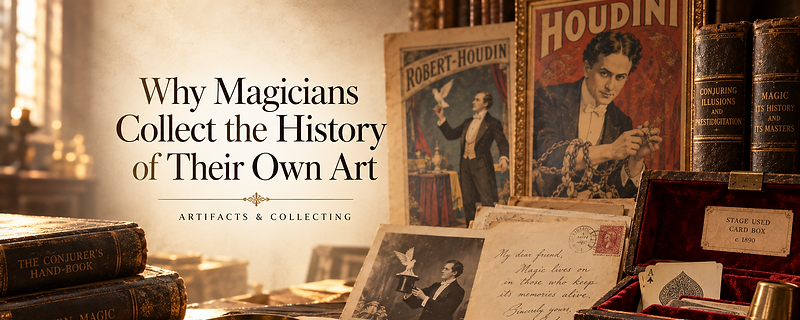
Why Magicians Collect the History of Their Own Art
Magicians have an unusually long tradition of becoming historians of their own art. They save books, apparatus, photographs, posters, letters, programs, manuscripts, and even seemingly insignificant scraps of paper because they understand how quickly a performance can disappear. From Harry Houdini and Robert Lund to Ricky Jay and David Copperfield, some of the people most determined to preserve magic have been magicians themselves.
By The Upchurch Collection of Magic
September 27, 2026

Magic has a peculiar relationship with its own past. Performers constantly borrow from it, study it, reinvent it, argue about it, and sometimes deliberately conceal it. A method developed generations ago can reappear inside a modern routine. An old book can contain an idea that suddenly becomes useful again. A forgotten poster may identify a performer, venue, or illusion that otherwise vanished from the record. Yet the performance itself leaves remarkably little behind.
That may explain why magicians have so often become collectors of magic.
The impulse is not difficult to understand. Someone who performs the art knows that the object an outsider dismisses as an old deck of cards, battered prop, handwritten notebook, or yellowing program may contain evidence that matters. Magicians also understand something particularly important about their own profession: when the person who knows the story disappears, the story can disappear with them.
Collecting therefore becomes more than nostalgia. At its best, it is a form of historical preservation performed by people who understand the language of the material they are trying to save.
An Art With an Ancient Past and an Imperfect Record
Magic is frequently described as one of the oldest performing arts, but its earliest history has to be approached carefully. Ancient Egyptian literature preserved in the Westcar Papyrus tells of a wonder-worker named Djedi performing extraordinary feats before King Khufu, including restoring the severed heads of animals. The surviving manuscript, however, was written many centuries after the reign in which the story is set, and scholars treat it as literature rather than evidence that a historical performer named Djedi actually presented a stage act in Khufu's court. Claims that an ancient Egyptian tomb scene definitively depicts the cups and balls are similarly debated. (Source: University College London)
That uncertainty illustrates the problem perfectly. The further back we look, the more magic history has to be reconstructed from stories, images, books, descriptions, and scattered surviving objects. Even much later material can be surprisingly fragile. Reginald Scot's The Discoverie of Witchcraft, published in 1584, survives as one of the most important early English printed sources describing sleight of hand and conjuring methods. Scot intended in part to expose supposed supernatural claims, yet his explanations became useful to generations of magicians and influenced later conjuring literature. Copies now preserved by institutions such as the Library of Congress have become evidence not only of individual tricks but of how people understood deception, witchcraft, skepticism, and performance in the sixteenth century. (Source: Library of Congress)
Magic history survives because somebody kept things like that.
The same principle applies to much less ancient material. A twentieth-century program, an annotated magic book, a photograph of an apparatus backstage, or a letter between two working magicians may appear ordinary while everyone involved is still alive. A century later, it may be the only surviving evidence explaining how a particular act developed.
Magicians Have Been Collecting Magicians for Generations
Perhaps the clearest example is Harry Houdini.. Houdini was not merely interested in documenting himself. He spent years assembling books, manuscripts, scrapbooks, photographs, and ephemera concerning magic, theater, spiritualism, witchcraft, and related subjects. The Harry Ransom Center's current Houdini's Library exhibition describes his collection as the product of a deliberate effort to study and preserve the long history of magic and theater. The Library of Congress likewise holds substantial material from Houdini's collecting, including books that bear his ownership and annotations. (Source: Harry Ransom Center)
That is significant because Houdini understood himself as part of a lineage. He studied earlier performers, accumulated their literature, collected the evidence they left behind, and preserved records of his own career with extraordinary intensity. The magician who became one of the most famous entertainers of his era was also helping preserve the history that preceded him.
The same pattern continued. Robert Lund, a journalist, magic historian, and collector, spent decades assembling the enormous private collection that eventually became the American Museum of Magic in Marshall, Michigan. Founded by Robert and Elaine Lund in 1978, the museum's holdings grew to include apparatus, illusions, more than 12,000 books, thousands of posters and photographs, letters, diaries, periodicals, costumes, scrapbooks, and approximately 350,000 pieces of ephemera. After the Lunds' deaths, the collection became the foundation of a nonprofit institution dedicated to keeping the history publicly accessible. (Source: American Museum of Magic)
That progression—from personal fascination to historical resource—is one of the recurring stories in magic collecting.
The Collector Often Sees What Everyone Else Misses
A magician may also recognize significance that is invisible to someone outside the art.
Imagine a box containing an old trick, several handwritten pages, a photograph, a dealer's instruction sheet, and a letter from another performer. To someone clearing an estate, it may look like miscellaneous paper surrounding an obsolete piece of equipment. To a knowledgeable collector, those materials may establish who created the trick, how it was originally performed, what changes were made, who owned it next, and how an idea moved from one magician to another.
This is particularly important because magic has always depended heavily on transmission. Knowledge moves through books and magazines, but also through lectures, apprenticeships, conversations, private correspondence, dealers, clubs, conventions, personal notebooks, and direct exchanges between performers. The surviving physical record can therefore reveal relationships that would otherwise be almost impossible to reconstruct.
Ricky Jay is a remarkable example of this kind of collecting. Jay was not only one of the great sleight-of-hand performers of his generation but a serious scholar of magic, deception, unusual entertainments, gambling, con artistry, and popular culture. Over more than half a century, he assembled books, broadsides, posters, handbills, manuscripts, prints, apparatus, and other ephemera stretching across centuries. Sotheby's described his approach as scholarly and noted that he searched bookstores and print shops during his travels while also acquiring material through relationships with older magicians and collectors. His collection eventually documented not only celebrated performers but obscure entertainers who might otherwise have almost disappeared from historical memory. (Source: Sothebys.com)
That is an important distinction. Collecting history is not simply acquiring famous names. Sometimes the most valuable act of preservation is recognizing importance before history has decided something is important.
Secrets Make Preservation More Complicated
Magicians also collect because their art has historically maintained an unusual relationship with secrecy. Methods are taught, sold, exchanged, published for specialized audiences, and sometimes deliberately withheld from the general public. The Society of American Magicians, founded at Martinka's magic shop in New York on May 10, 1902, explicitly includes opposition to the unnecessary public exposure of magical effects among its longstanding principles. (Source: Magic Sam)
That culture has helped protect methods, but it can also make historical preservation difficult. A secret that exists only in one performer's memory can vanish permanently. A privately circulated manuscript can disappear. An apparatus may survive while nobody remembers how it was operated. A notebook that looks meaningless to a family member may contain years of technical development.
This creates an important distinction between preservation and exposure. Saving a magician's notebook does not mean every page should immediately be published online. Documenting the internal mechanism of an illusion does not require displaying that mechanism to every museum visitor. A collection can preserve restricted information for future scholarship while still respecting the traditions, rights, and legitimate concerns of performers and creators.
In that sense, magic collecting frequently has two audiences: the public that deserves access to the history of the art, and the specialized researcher or practitioner who may need access to deeper technical material. Preserving both levels of information is one of the things that distinguishes a serious archive from a display of memorabilia.
Collecting Can Become Research
The great magic collections are valuable because they allow objects to speak to one another.
One poster can be beautiful. Twenty posters from the same performer may reveal how that performer's public image evolved. A single edition of a book documents a text. Multiple editions can reveal revisions, changing terminology, or shifts in the way a method was taught. Correspondence can connect an inventor to a performer. A photograph can show that apparatus in use. A program can establish that the effect had entered the act by a particular date.
The collection becomes more informative as relationships between objects become visible.
This is why institutional collections and specialist research libraries matter so much. The Conjuring Arts Research Center maintains thousands of volumes, manuscripts, correspondence, periodicals, and apparatus devoted to magic and allied arts, including substantial holdings predating 1900. Its stated purpose includes preservation, interpretation, and scholarship rather than simple accumulation. (Source: Conjuring Arts)
Private collections can serve a similar function. David Copperfield''s International Museum and Library of the Conjuring Arts has grown into one of the world's largest collections of magic material. Guinness World Records documented 150,000 items there in 2005, while reporting on the collection in 2018 described it as containing more than 200,000 artifacts and pieces of ephemera. Its holdings include books, posters, apparatus, automata, and major objects associated with performers who preceded Copperfield by generations. (Source: Guinness World Records)
A working magician can therefore become both practitioner and historian. What begins as curiosity about the people who came before can grow into an archive capable of supporting research long after the collector's own performances have ended.
Why Magicians Care About Lineage
There is another reason performers collect their own history: magic is unusually conscious of lineage.
Magicians routinely argue about who invented an effect, who developed a particular handling, who first published an idea, whether two methods arose independently, and whether proper credit has been given. These questions can sound obsessive to outsiders, but attribution matters in a field where ideas are continuously adapted and where the secret method behind an effect may be more historically significant than the object audiences actually saw.
Old books and manuscripts can settle those questions. So can dated letters, advertisements, photographs, dealer catalogs, programs, and notebooks. The archive provides a memory more reliable than recollection alone.
It can also humble the modern performer.
An idea that seems revolutionary may appear in a book printed a century earlier. A supposedly modern presentation may have an unexpected ancestor. A trick remembered under the name of its most famous performer may turn out to have originated with someone almost forgotten.
Collecting connects the magician to those predecessors. It reminds the practitioner that the art did not begin with the current generation and will not end with it.
What Happens When Collections Disappear?
Collecting does not automatically guarantee preservation.
Private collections can be broken apart after the collector dies. Books are separated from annotations. Correspondence is sold one letter at a time. Posters move into decorative collections without their accompanying documentation. Apparatus loses its provenance. Families understandably dispose of material whose significance they cannot identify.
Sometimes dispersion puts important objects into the hands of new collectors who preserve them carefully. Auctions can also document collections and bring forgotten material back into public view. But once a coherent archive is divided, relationships among its objects can become much harder to recover. Ricky Jay's collection, for example, was notable precisely because its material reflected decades of interconnected scholarly interests; its later auction catalogs now become part of the documentation of what that collection once contained. (Source: Sothebys.com)
Robert and Elaine Lund took another path by arranging for their collection to continue as the American Museum of Magic. Houdini's collecting survives substantially through institutions such as the Harry Ransom Center and Library of Congress. Different collections will have different futures, but the underlying question eventually confronts every serious collector:
What happens to this history when I am no longer here to explain it?
That may be the most important preservation question of all.
Collecting the Present Before It Becomes the Past
There is a temptation to think of magic history as something that has already happened: Houdini handcuffs, Kellar posters, Thurston programs, nineteenth-century books, and apparatus from vanished theaters.
But every historical artifact was once contemporary.
Today's inexpensive show poster may be tomorrow's scarce record of an early career. An email from a performer may become important correspondence. A ticket stub may establish where a production appeared. A photograph taken casually after a show may eventually become one of the clearest surviving records of a performer, venue, or period.
Digital technology has made documentation easier while creating a new kind of fragility. Websites disappear. Social-media accounts are deleted. Cloud services close. File formats change. Digital photographs can exist in thousands of copies and still disappear because nobody deliberately preserved one with the names, date, location, and context attached.
Physical and digital preservation therefore increasingly belong to the same project.
For The Upchurch Collection of Magic, this is one of the reasons collecting cannot be limited to acquiring old or expensive things. The purpose is to preserve evidence of the art across different periods and levels of performance: celebrated figures and regional performers, significant apparatus and fragile paper, formal publications and personal correspondence, objects already recognized as historical and objects whose historical importance may not become obvious for decades.
Magicians collect the history of magic because they know better than almost anyone how quickly an impossible moment disappears.
The trick ends.
The audience goes home.
The performer eventually leaves the stage.
What remains are the objects, records, photographs, writings, and stories someone cared enough to keep.
Collecting is one of the ways magic remembers itself.
Continue Reading
Related Stories

Artifacts & Collecting
Why Autographs and Personal Correspondence Matter in a Magic Collection
An autograph can establish a direct connection to a performer, but a letter can do something even more important: it can preserve the performer's voice. In a field built around public personas, secrecy, collaboration, and constant reinvention, signed photographs, inscriptions, letters, notes, and correspondence can reveal the human relationships and working history that posters and props alone cannot.
September 27, 2026

Artifacts & Collecting
Why Old Magic Posters, Programs, and Ephemera Matter
Magic ephemera was created to be temporary. Posters were pasted to walls, programs were folded into pockets, tickets were torn at theater doors, and handbills were discarded once the show left town. Precisely because these objects were never expected to become history, the examples that survive can reveal details about performers, theaters, touring routes, illusions, audiences, and careers that more formal histories often miss.
September 27, 2026
Follow the Collection
Receive new Stories and collection updates
Receive new Stories, research, acquisitions, and collection updates by email.