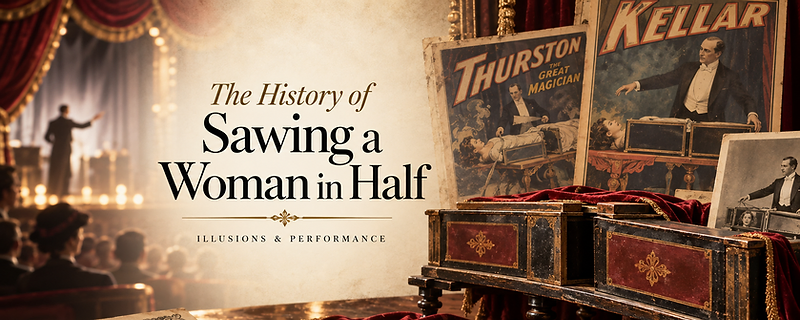
The History of Sawing a Woman in Half
Few images are more immediately associated with stage magic than a magician apparently sawing a human being in half. Born into modern theatrical magic in the early twentieth century, the illusion evolved from P.T. Selbit's enclosed wooden box into visible-head-and-feet versions, buzz saws, thin cabinets, and eventually performances in which the magician became the victim. Its history reveals not only changing technology, but changing ideas about danger, spectacle, assistants, gender, and what audiences need to see in order to believe the impossible.
By The Upchurch Collection of Magic
September 27, 2026
Ask someone who has never attended a magic show to picture a stage illusion, and there is a good chance they will imagine a magician sawing a woman in half. The image has escaped the theater almost completely. It appears in cartoons, advertising, comedy, television, Halloween costumes, children's toys, and visual shorthand for magic itself. A box, a woman, and a saw are enough to communicate the entire idea.
That familiarity makes it easy to forget how strange the illusion really is. The magician does not merely make something disappear or produce an object from nowhere. A human body is apparently subjected to an act that should be catastrophic, the damage is made increasingly difficult to deny, and then the performer reverses the impossible. The assistant stands up unharmed.
The illusion has survived for more than a century because its premise requires almost no explanation. Everyone understands what a saw is supposed to do. Everyone understands what should happen if it passes through a human body. The audience therefore understands the danger before the magician says a word.
What changed over the decades was not that basic idea, but how much evidence audiences demanded before they were willing to believe they had seen the impossible.
Before the Saw
Stories about magicians dividing, decapitating, destroying, and restoring human bodies long predate the twentieth century. Magical literature contains earlier descriptions and legends, including stories associated with Jean-Eugène Robert-Houdin,, and later accounts sometimes attempted to push the origin of sawing illusions much further into the past. The problem is that the historical evidence becomes increasingly uncertain the farther back those claims are taken. The ancient origins sometimes attached to the illusion are not securely documented, and the modern history should not be presented as though a direct line can be traced from antiquity to the familiar stage effect.
The important turning point came in London at the beginning of the 1920s. British magician P.T. Selbit,, born Percy Thomas Tibbles, is generally credited with introducing the modern sawing illusion to the public at the Finsbury Park Empire on January 17, 1921. Selbit had demonstrated the idea privately to theatrical professionals shortly before its public debut, but the 1921 engagement became the landmark from which the modern history of the illusion is usually dated. His public assistant was Betty Barker; Jan Glenrose had participated in the earlier demonstration.(Source: Guinness World Records)
Selbit called the effect “Sawing Through a Woman.” What his audience saw, however, was quite different from what most people now imagine when they hear the phrase.
P.T. Selbit Puts a Woman in the Box
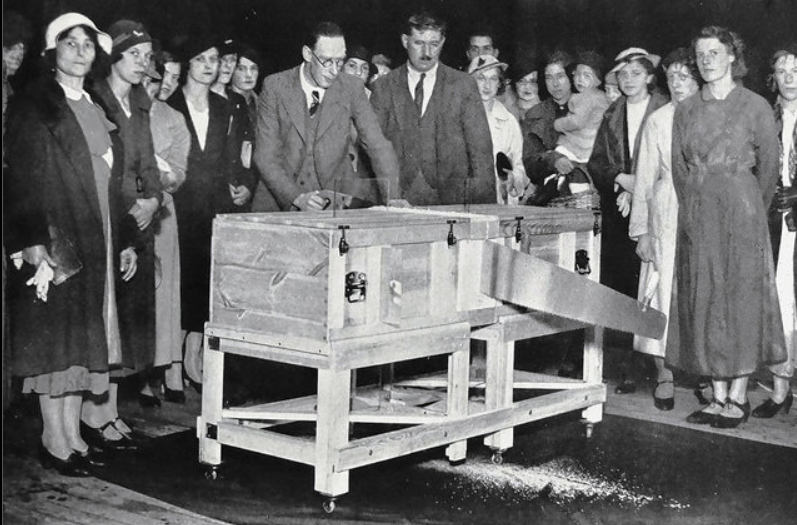
Selbit's presentation used a large, plain wooden container that has often been compared to a coffin. His assistant was placed completely inside it and disappeared from view. Ropes attached to her helped reinforce the impression that she remained confined while the magician proceeded to saw through the box. When the ordeal ended, the container was opened and the assistant emerged unharmed. (Source: Cabinet Magazine)
The visual power of Selbit's illusion came partly from its crudeness. This was not an elegant cabinet decorated to resemble a piece of fine furniture. The box and saw made the procedure appear almost industrial. The audience knew a living person had entered the container, understood that she supposedly had nowhere to go, and then watched a real-looking saw cut through the space she occupied.
That alone was enough to create a sensation. But from the perspective of later illusion design, Selbit's version contained an obvious limitation: once the assistant entered the box, the audience could no longer see her. The entire dramatic question therefore became whether the spectators truly believed she remained exactly where the magician claimed she was.
Another magician quickly recognized that problem.
Horace Goldin Makes the Victim Visible
Only months later, Horace Goldin introduced his own approach. On June 3, 1921, at the Society of American Magicians annual banquet at New York's McAlpin Hotel, Goldin presented a version in which the head and feet of the person being divided remained visible. Interestingly, his first presentation used a male assistant rather than the female victim that would later become so closely associated with the illusion. (Source: Guinness World Records)
Goldin's contribution was enormously important because it strengthened the visual argument. The assistant did not simply disappear inside a mysterious crate. A head remained visible at one end. Feet remained visible at the other. The box could be divided and its sections separated, while both ends of the supposedly bisected person continued to appear alive.
That image became much closer to the version embedded in popular culture today. It also illustrates a pattern that runs throughout the history of stage illusion: each generation tries to eliminate the explanation the previous generation made possible.
If the audience suspected the person had escaped from Selbit's hidden box, show them the head and feet.
If the box still looked large enough to conceal the method, make the box smaller.
If the box itself became suspicious, remove it.
If a hand saw no longer looked dangerous enough, bring out a powered blade.
The history of sawing a person in half became, in large part, a history of progressively removing places for the audience's explanation to hide.
Making the Box Thinner
The large cabinets used in early versions eventually created another problem. Audiences could look at a deep box and imagine that perhaps the assistant had simply moved somewhere inside it. Even without understanding the method, the existence of unused space offered a psychologically satisfying explanation.
Later designers attacked that weakness by reducing the apparent space available to the assistant. One of the most important developments was the thin-model sawing, strongly associated with Turkish magician and illusion designer Zati Sungur, who developed his approach during the 1930s. Magic historian Mike Caveney''s work credits Sungur with an important role in the development of the thin sawing, although the history also includes related work by figures such as Guy Jarrett and later builders and performers who refined the design. (Source: Mike Caveney's Magic Words)
The basic visual argument became devastatingly simple. The assistant's head could be seen at one end. Her feet could be seen at the other. The cabinet between them appeared so shallow that there seemed to be nowhere for a human body to evade what was happening in the middle.
From an audience's perspective, the problem had become much harder to solve.
That evolution is a useful reminder that great illusion design is often not about making something mechanically more complicated. Sometimes it is about understanding what explanation the audience is relying upon and taking that explanation away.
When the Saw Became the Star
The weapon itself also grew more theatrical. The ordinary hand saw of Selbit's era eventually gave way in some versions to enormous circular blades and powered buzz saws. The transformation changed the emotional character of the illusion. A hand saw required the magician to deliberately work through the box. A roaring mechanical blade introduced speed, noise, machinery, and the possibility that events might suddenly move beyond human control.
Goldin eventually developed a boxless buzz-saw presentation, and later performers continued pushing the imagery toward greater apparent danger. Harry Blackstone Sr. incorporated the buzz-saw theme into his repertoire, and Orson Welles famously used versions of the illusion with prominent actresses during his Mercury Wonder Show era. Over time, performers discovered that the sawing premise could be presented as comedy, horror, suspense, elegant illusion, or apparent catastrophe without changing its essential structure.(Source: McGill University)
Perhaps one of the strangest demonstrations of its emotional power occurred on British television in 1956. Indian magician P.C. Sorcar performed a buzz-saw illusion with his assistant Dipty Dey during a live BBC Panorama appearance. The segment ended at precisely the wrong—or, from a publicity standpoint, perhaps the perfect—moment. Viewers were left without immediately seeing the assistant restored, and the BBC received calls from people concerned that they had witnessed a genuine disaster. Contemporary newspaper coverage reassured them the following day that Dey was alive and well. (Source: Telegraph India)
The incident demonstrated something important about sawing illusions: despite decades of familiarity, the image could still make audiences momentarily wonder whether something had gone terribly wrong.
The Assistant Was Never Just a Prop
The traditional title—Sawing a Woman in Half—also reveals something important about the illusion's history.
For much of twentieth-century stage magic, the magician was usually male and the person placed in danger was usually female. The glamorous female assistant became one of the most recognizable conventions in illusion shows, and the sawing effect helped establish that visual relationship particularly strongly.
But describing the assistant simply as a victim misses much of what the job actually requires. The person inside a stage illusion is a performer. Timing, body control, confidence, choreography, awareness of the apparatus, and the ability to maintain the theatrical illusion are all part of the work. The audience may direct its applause toward the person holding the saw, but the person apparently being divided is frequently doing highly skilled work of her own.
Selbit's original history contains an especially revealing episode. Shortly after the illusion's debut, he offered prominent suffragist Christabel Pankhurst paid work appearing as the woman in his sawing illusion. She declined. Historians and performers, including Naomi Paxton and Jim Steinmeyer,, have examined the episode in the context of women's suffrage and the changing social position of women in Britain. The timing was striking: Selbit's illusion became a sensation only a few years after some British women gained the parliamentary vote, and his attempt to recruit one of the movement's best-known figures made the symbolism unusually explicit. That does not prove that audiences embraced the illusion for one simple political reason, but it makes the gendered history of the effect difficult to dismiss as accidental. (Source: Encyclopedia)
Modern performers have approached that inheritance in very different ways. Some preserve the traditional presentation, some reverse the gender roles, some make the magician the person being divided, and others deliberately parody the old magician-and-assistant relationship. The illusion has survived partly because its structure is flexible enough to absorb those changes.
David Copperfield Gets Under the Saw
One of the most important modern reversals came when David Copperfield made himself the endangered person.
His Death Saw presentation reframed the classic illusion as an escape that appeared to go wrong. Rather than standing safely beside the apparatus while an assistant faced the blade, Copperfield was restrained beneath a large descending circular saw. He apparently failed to escape in time, the blade passed through him, and the two sections of his body were separated. Contemporary reporting from 1988 described the Death Saw as part of his touring show, while the illusion has since become one of the best-known modern variations on the sawing theme. (Source: Los Angeles Times)
The change was more significant than simply substituting one body for another. The dramatic story shifted. The magician was no longer demonstrating complete control over another person's apparent destruction. He became vulnerable himself. What should have been an escape became an apparent failure, and the magical restoration followed catastrophe rather than confident procedure.
Copperfield later explored the theme of dividing his own body again through other illusions, demonstrating how far the basic idea had traveled from Selbit's wooden crate.
Yet the fundamental image remained recognizable.
A body is whole.
Something impossible divides it.
The two parts exist separately.
And somehow the person survives.
Why Sawing Became an Icon
Thousands of stage illusions have been invented over the last century. Very few became part of everyday visual language.
Sawing a person in half did because it combines several unusually powerful ideas in a form that can be understood immediately. There is apparent danger. There is transformation. There is destruction followed by restoration. The audience does not need to understand specialized apparatus, mathematical principles, or the rules of a card game. A child can understand what is supposedly about to happen before the saw makes its first movement.
The illusion also creates an unusual dramatic structure. Many tricks end when the impossible event occurs: the object vanishes, the person appears, the prediction is revealed. Sawing has two climaxes. First comes the destruction. Then comes the restoration.
The magician therefore gets to convince the audience that something terrible has happened and then solve the very problem that was just created.
That pattern has allowed the illusion to survive enormous changes in performance style. It can be grotesque or elegant, frightening or funny. The apparatus can look Victorian, industrial, futuristic, or deliberately ordinary. The “victim” can be a woman, a man, the magician, or—in parody—almost anything else.
What matters is that the audience understands the impossible proposition.
More Than a Cliché
Because sawing a woman in half became so famous, it eventually became a cliché. Cartoons can reduce a magician to a top hat, wand, rabbit, and a woman sticking out of a box. Comedy acts can present a saw and cabinet without explanation because the audience already knows what they mean.
But clichés usually become clichés because something was once powerful enough to be copied endlessly.
In 1921, Selbit's audience was not seeing an old magic joke. They were encountering a startling new theatrical image. Goldin immediately recognized that the premise could be made more visual. Sungur and others reduced the apparent hiding space. Buzz-saw performers intensified the danger. Sorcar discovered how terrifying the illusion could become through television. Copperfield eventually put the magician himself beneath the blade.
Each version asked essentially the same question in a new way:
How much more can we show the audience and still make the impossible survive?
That may be the most important reason the illusion deserves a place in the history of magic. It is not simply an old trick involving a box and a saw. Its evolution documents more than a century of changing theatrical expectations. Audiences became more skeptical, apparatus became more deceptive, assistants became more visible, danger became more dramatic, and performers continually rebuilt the effect around whatever explanation spectators thought they had found.
The apparatus changed.
The presentation changed.
Even the person under the saw changed.
But the central image proved almost indestructible.
More than a century after P.T. Selbit closed the lid on his wooden box in London, audiences still understand exactly what a magician means when the saw comes out.
The woman was never really the thing being divided. The magician was dividing reality into two possibilities: what the audience knew must be true, and what they had just seen with their own eyes.
Continue Reading
Related Stories

Illusions & Performance
How Close-Up Magic Became a Serious Art Form
Close-up magic uses some of the smallest objects in the magician's repertoire—cards, coins, rings, cups, balls, and borrowed objects—yet it can create some of the strongest illusions. Its rise from informal demonstrations and supporting material to a respected performance discipline changed the way magicians thought about technique, psychology, presentation, and the relationship between performer and audience.
September 28, 2026

Illusions & Performance
The Evolution of the Escape Act Before and After Houdini
Harry Houdini did not invent the escape act, but he changed its scale, language, and public meaning so completely that escapology became inseparable from his name. Before Houdini, restraints often appeared inside spiritualist demonstrations, challenge acts, and theatrical magic. After him, escape artists inherited both a vocabulary of chains, straitjackets, water, and confinement—and the nearly impossible problem of performing in the shadow of the man who had made escape itself a form of celebrity.
September 27, 2026
Follow the Collection
Receive new Stories and collection updates
Receive new Stories, research, acquisitions, and collection updates by email.