
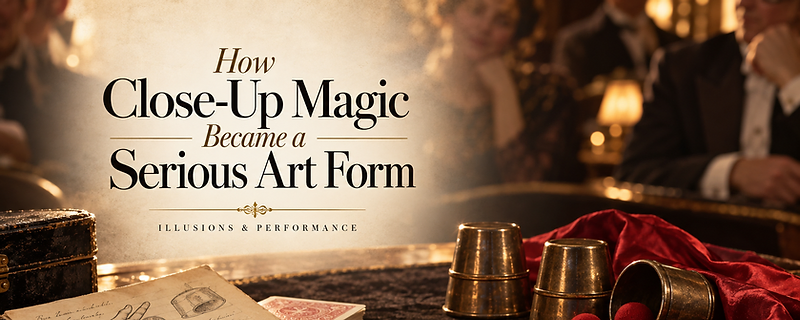
How Close-Up Magic Became a Serious Art Form
Close-up magic uses some of the smallest objects in the magician's repertoire—cards, coins, rings, cups, balls, and borrowed objects—yet it can create some of the strongest illusions. Its rise from informal demonstrations and supporting material to a respected performance discipline changed the way magicians thought about technique, psychology, presentation, and the relationship between performer and audience.
By The Upchurch Collection of Magic
September 28, 2026
A magician on a large stage has distance, lighting, scenery, music, assistants, and elaborate apparatus available to help create an illusion. A close-up magician may have none of those things. There may be no curtain, no orchestra, and nowhere to hide. The audience can be sitting a few feet away—or directly across the table—watching a deck of cards that they have just shuffled or a coin that was borrowed from their own pocket.
That apparent simplicity is deceptive. Close-up magic can be one of the most technically demanding and psychologically sophisticated forms of the art because almost everything depends on the performer. Technique must survive close observation. Timing becomes visible. Awkward movement cannot disappear into theatrical distance. The magician has to manage attention, communicate clearly, establish trust, create surprise, and often interact directly with the same people being deceived.
What once might have been dismissed as a collection of "pocket tricks" gradually developed into a discipline with its own masters, literature, venues, theories, and standards of excellence. Its rise also helped change a much larger idea within magic: that the size of an illusion has very little to do with the size of the experience it can create.
Magic Without the Big Stage
Small-scale magic is far older than the modern term close-up magic. Cups and balls, coin manipulation, card tricks, shell games, mathematical recreations, and other forms of sleight of hand existed long before specialized close-up theaters or television cameras. Conjurors demonstrated portable effects in markets, drawing rooms, fairs, taverns, private homes, and wherever audiences could gather. Much of this material required little equipment and could travel easily with the performer.
During the nineteenth century, however, some of the most visible developments in professional magic were occurring on theatrical stages. Performers such as Jean-Eugène Robert-Houdin helped establish conjuring as respectable theatrical entertainment, while later generations expanded stage magic into increasingly elaborate productions. During the great illusion shows of the late nineteenth and early twentieth centuries, audiences could encounter levitations, vanishes, transformations, stage machinery, costumes, assistants, and large apparatus designed to fill a theater.
Yet sleight of hand never disappeared. Card manipulation, coin work, billiard-ball routines, and other forms of technically demanding magic remained important parts of many performers' repertoires. Smaller effects also flourished away from the main stage in private performances and social settings. The distinction was not that close-up magic suddenly appeared in the twentieth century. What changed was the extent to which magicians began treating it as a complete artistic form rather than merely one component of a larger act.
When Small Magic Became Serious Magic
That change cannot be credited to one performer, but several twentieth-century magicians were particularly influential in establishing the intellectual and artistic depth of close-up work.
Dai Vernon, sometimes called "The Professor," became one of the defining figures in modern close-up magic. His importance was not simply that he possessed extraordinary technical ability. Vernon encouraged magicians to think critically about natural movement, economy, construction, and the difference between executing a secret move and creating a convincing illusion. His influence extended through generations of performers who studied not merely what he did, but why his magic appeared so effortless.
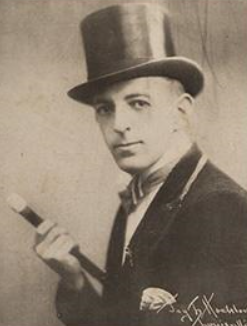
Tony Slydini* developed another highly influential approach. His work demonstrated how rhythm, body language, timing, eye contact, and the management of attention could become inseparable from method. Watching Slydini was not simply watching someone execute hidden moves. The performer's entire interaction with the spectator became part of the deception.
Other figures—including Ed Marlo, Juan Tamariz, Larry Jennings, Michael Skinner, and many more—continued expanding the technical and theoretical vocabulary of close-up magic. Card magic alone developed into an enormous field involving false shuffles, controls, palms, switches, forces, passes, counts, flourishes, memorized arrangements, mathematical principles, psychological subtleties, and countless combinations of methods.
By this point, calling close-up magic a collection of simple tricks no longer made much sense. It had become a discipline in which performers could spend a lifetime refining the handling of a single deck of cards.
Technique Is Only the Beginning
Close-up magic is often associated with sleight of hand, and for good reason. A convincing false transfer, invisible card control, coin vanish, secret load, or palm may require hundreds or thousands of repetitions before it can be performed naturally under close observation.
But difficult technique does not automatically produce good magic.
A musician can play scales rapidly without moving an audience. A painter can demonstrate extraordinary control of a brush without producing a memorable painting. Close-up magic presents the same problem. The secret technique is a tool; the audience experiences the effect.
That distinction became increasingly important as close-up magic matured. Serious practitioners began examining questions that went far beyond finger dexterity. When should the audience believe an object changed hands? What should they remember about the sequence afterward? Where should they be looking at the critical moment? How long should a pause last before the revelation? Should an impossible event happen suddenly or gradually? How can several effects be structured so that each one makes the next more impossible?
Misdirection is part of this, but the word is sometimes misunderstood. It does not simply mean making someone look away while the magician does something secret. Good attention management can involve directing interest toward something meaningful, using conversation, timing, movement, expectation, eye contact, memory, and the natural logic of an action. Ideally, the audience does not feel that its attention was manipulated at all.
The closer the spectator sits, the more these details matter.
Everyday Objects Made the Impossible Feel Closer
Close-up magic also gained power from the ordinariness of its objects.
A large illusion cabinet is obviously a magician's piece of equipment. An audience knows from the moment it sees the apparatus that something has been designed to happen inside it. That does not diminish the illusion, but it establishes a particular theatrical relationship.
A borrowed quarter creates a different one.
So does a shuffled deck of cards, a wedding ring, a rubber band, a cup, a pen, a bill, or another object the spectator believes they already understand.
When something impossible happens to an ordinary object at close range, the audience loses one of its easiest explanations. There is no enormous machine to blame. Sometimes the object belongs to the spectator. Sometimes the spectator has been holding it.
This is one reason close-up magic can feel unusually personal. The impossible event does not occur fifty feet away under theatrical lighting. It happens on the table between performer and spectator.
The scale becomes smaller.
The mystery can become larger.
The Close-Up Room Became Its Own Theater
As the art developed, close-up magic increasingly found spaces designed specifically for it. Magic clubs, private rooms, restaurants, convention sessions, dedicated close-up theaters, and informal gatherings allowed performers to present material in conditions very different from the traditional stage.
Perhaps no institution became more closely associated with the development of modern close-up magic than The Magic Castle in Hollywood. Its close-up rooms gave generations of performers an environment in which small-scale magic could be presented as the main event rather than as an interlude before a larger show. Audiences entered specifically to watch a magician work with cards, coins, cups, and other small objects from only a few feet away.
That change in setting helped change perception. Putting close-up magic in a dedicated performance room told the audience that the work deserved sustained attention. The magician was no longer someone wandering from table to table providing background entertainment. The audience sat down, became quiet, and watched.
A deck of cards had acquired a stage.
Specialized venues also became important places for magicians themselves. Performers could watch one another, exchange techniques, argue about theory, refine material, and see how effects survived in front of real audiences. The culture surrounding close-up magic became part workshop, part laboratory, and part theater.
Television Put Everyone in the Front Row
Television gave close-up magic another enormous advantage: the camera could place millions of people closer to the magician's hands than almost any theater audience had ever been.
Cards and coins could suddenly fill the screen. A subtle facial expression could matter. Small objects no longer had to compete with the size of a stage. Effects previously best suited to a small group could become national entertainment.
But television also raised the stakes. The camera could preserve an awkward movement, provide an unforgiving view of the hands, and allow a performance to be studied repeatedly. More importantly, televised close-up magic had to maintain credibility with viewers who understood that editing and camera angles could themselves create deception.
Different performers solved that problem in different ways. Some emphasized continuous performance and visible spectators. Others used television's intimacy deliberately, allowing the camera to recreate the feeling of standing only inches away.
Later, David Blaine demonstrated how powerful that intimacy could become when combined with ordinary surroundings. His early television work stripped away much of the conventional visual language of televised magic. Instead of elaborate sets and formal costumes, viewers saw casual clothes, sidewalks, ordinary people, and effects performed at conversational distance. The astonishment of the spectators became part of the presentation.
The setting suggested that this could happen anywhere.
That idea owed much to the traditions of close-up magic that had been developing for generations.
The Audience Became Part of the Method
Close-up magic differs from many performing arts because the audience is often physically involved in what happens. Spectators shuffle cards, sign objects, make choices, hold coins, cover the magician's hands, examine props, or discover impossible objects themselves.
That involvement creates risk.
A theater audience can usually be treated as a group. A close-up magician may need to understand several individual personalities at once. One spectator wants to participate. Another is nervous. Someone is determined to catch the secret. Someone else is afraid of being embarrassed. Another has already had too much to drink. A child may grab something unexpectedly. A technically perfect routine can fail as entertainment if the performer cannot manage the people sitting around the table.
For this reason, serious close-up performance requires social skill alongside technical ability. The magician has to establish authority without becoming confrontational, involve spectators without humiliating them, and maintain enough control to protect the method while making the experience feel spontaneous.
At its best, the spectator does not feel like a target.
They feel like a participant in something impossible.
That is a very different skill from simply knowing how the trick works.
The Literature Became Enormous
Another sign that close-up magic had become a serious discipline was the extraordinary body of literature that developed around it.
Entire books could be devoted to one sleight, one performer, one branch of card technique, or one approach to constructing routines. Magazines documented new methods and debates. Lectures and conventions allowed performers to teach work that might have taken years to develop. Later, instructional video and digital publishing expanded that exchange even further.
This created an unusual tradition in which close-up magic was simultaneously secretive and intensely documented. Magicians protected methods from general audiences while producing an enormous technical literature for one another.
For future historians, those publications matter for reasons beyond learning tricks. They record the development of ideas. Different editions can reveal how methods changed. Notes and annotations may show what an individual performer actually used. Correspondence can document disputes about invention and credit. Photographs can preserve hand positions and props that no longer exist.
The history of close-up magic therefore survives not only in decks of cards and coins, but in the written conversation surrounding them.
From Card Table to Phone Screen
Close-up magic has proven unusually adaptable to the digital age because it was already designed for intimate viewing. A smartphone camera can reproduce something surprisingly close to the visual scale of a spectator sitting across a table.
That has allowed technically skilled performers to reach audiences that earlier close-up magicians could scarcely have imagined. Tutorials, performances, competitions, convention footage, archival videos, and short-form social media have created a global exchange of techniques and styles.
At the same time, digital presentation introduces new questions. A video can be edited. Reactions can be selected. Angles can hide more than a live spectator would allow. Effects can be designed specifically for a camera rather than for an audience physically present in the room.
The distinction between magic performed for people and magic constructed for a recording has therefore become increasingly important.
Neither is necessarily illegitimate, but they are different experiences.
The defining challenge of close-up magic remains what it has always been: creating the conviction that something impossible happened right there.
How Small Can a Great Illusion Be?
The history of close-up magic ultimately challenges one of the easiest assumptions to make about illusion: that bigger must be better.
A magician can make an automobile appear, levitate a person, vanish from a stage, or present apparatus that requires an entire truck to transport. Those feats can be extraordinary.
But a magician can also place a coin in someone's hand, ask them to close their fingers, and create a moment they remember for the rest of their life.
There is no contradiction between those forms of magic. They solve different artistic problems.
The grand illusion asks how large wonder can become.
Close-up magic asks how near it can come.
Its transformation into a serious art form did not occur because cards and coins somehow became more important than stage apparatus. It happened because generations of performers demonstrated how much thought, technique, psychology, personality, and theatrical structure could be concentrated into a few feet of space.
No orchestra is required.
No enormous apparatus is necessary.
Sometimes there is only a magician, a spectator, and an ordinary object sitting between them.
Then the object does something it should not be able to do.
And from only a few inches away, there is nowhere for the impossible to hide.
Continue Reading
Related Stories

Illusions & Performance
The Evolution of the Escape Act Before and After Houdini
Harry Houdini did not invent the escape act, but he changed its scale, language, and public meaning so completely that escapology became inseparable from his name. Before Houdini, restraints often appeared inside spiritualist demonstrations, challenge acts, and theatrical magic. After him, escape artists inherited both a vocabulary of chains, straitjackets, water, and confinement—and the nearly impossible problem of performing in the shadow of the man who had made escape itself a form of celebrity.
September 27, 2026

Illusions & Performance
The History of Sawing a Woman in Half
Few images are more immediately associated with stage magic than a magician apparently sawing a human being in half. Born into modern theatrical magic in the early twentieth century, the illusion evolved from P.T. Selbit's enclosed wooden box into visible-head-and-feet versions, buzz saws, thin cabinets, and eventually performances in which the magician became the victim. Its history reveals not only changing technology, but changing ideas about danger, spectacle, assistants, gender, and what audiences need to see in order to believe the impossible.
September 27, 2026
Follow the Collection
Receive new Stories and collection updates
Receive new Stories, research, acquisitions, and collection updates by email.