From the Audience to the Archive
Before there was a collection, there was the feeling—the mystery of seeing something that seemed impossible, the wonder of not knowing how it had been done, and sometimes the irresistible urge to solve the puzzle. Years of watching magic on television, at fairs and festivals, in local performances, and eventually in major theaters helped shape the ideas that became The Upchurch Collection of Magic.
By Wesley Upchurch
September 30, 2026
Before there was a collection, there was the feeling.
Growing up, I remember watching David Copperfield make the impossible seem real on a grand scale—things like making the Statue of Liberty disappear. I remember David Blaine taking almost the opposite approach—pushing the limits of human endurance and demonstrating simple and direct effects on the street in everyday situations, which somehow seemed even harder to explain. And there was Criss Angel, who was pushing boundaries in his presentation, turning magic into something darker, louder, and more theatrical.
Each of their styles was completely different, but they induced some version of the same reaction in me. A mixture of mystery, awe, wonder, and occasionally shock at what I'd just witnessed. For my inquisitive young mind, this feeling was often accompanied by an immediate desire to solve the puzzle.
Sometimes I wanted to know how do they do that? But, sometimes not knowing was better.
Both reactions stayed with me. But magic was never something I experienced only through famous performers on television. Some of the most mesmerizing moments happened much closer to home.
I remember Grayson Smith performing at one of our Boy Scout Courts of Honor. There were magicians at fairs, performers incorporated into circus acts, demonstrations at art festivals, a friend's birthday party, and other encounters that probably lasted only a few minutes.
In these settings, there was no famous theater marquee. No television audience. No multimillion-dollar production. And none of that mattered. The moments stayed with me.
For a child sitting in a folding chair or standing near a temporary stage, the performer's fame was largely irrelevant. Something impossible had apparently just happened in front of me, and I wanted to understand it.
I didn't know anything then about provenance, archives, historical preservation, or museum collections.
I just knew the feeling.
Years later, I would realize how much that feeling mattered.
Years of watching live magic, meeting performers, and preserving pieces of those experiences eventually helped inspire The Upchurch Collection of Magic.
From the Screen to the Stage
As I got older, watching magic increasingly became seeing magic.
I've been fortunate to see performers including Penn & Teller, David Copperfield, Criss Angel, Nathan Burton, Kristen Johnson—Lady Houdini, Brian Ledbetter, and many others.
Some were enormous Las Vegas productions. Others were Branson shows, regional performances, fair presentations, or community events. That range eventually became important to the way I think about magic.
A major casino production and a magician performing at a local event may exist at completely different scales. One might have millions of dollars in scenery, lighting, sound, performers, and theatrical technology behind it. The other may depend almost entirely on one person standing in front of an audience and holding its attention. Yet, they share one important characteristic.
When the performance is over, it is gone.
Those experiences made something very clear to me years before I ever thought about museum work:
Magic is temporary.
A show that exists tonight may not exist in the same form five years from now.
I learned that firsthand.
I saw Criss Angel's BeLIEve twice, during noticeably different stages of the production.

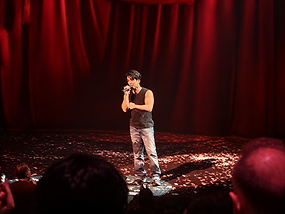
The earlier version I experienced retained much more of the Cirque-style theatrical environment associated with the show's original concept. The magic existed inside a larger, more surreal production, with more of the staging and theatrical elements associated with its Cirque du Soleil origins.
When I returned later, it had changed considerably. The emphasis had moved much more directly toward Angel himself and toward the style audiences knew from his television work. It felt much more like Mindfreak brought onto a live stage—harder-edged, faster, more rock-driven, more interactive, and much more densely packed with magic and illusion.
It was still called BeLIEve. But it was not really the same BeLIEve I had seen before.
I experienced something similar with David Copperfield, but in a somewhat opposite order.
The earlier Copperfield production I saw was built much more around the rapid succession of individual grand illusions, intermixed with audience interactions. I remember effects such as the motorcycle appearance, the Death Saw, and a magic routine involving his pet duck, Webster, and a bucket. This was mixed with Lucky Number 13, where he made a group of audience members vanish, and his lottery prediction material. The show faithfully reproduced the polished, large-scale illusion presentation and romantic elements of his television specials.
Years later, I returned to something very different. The later production relied heavily on his storytelling, using magic as a tool to explore grief, memory, and nostalgia, making the show less reminiscent of his television career, yet somehow more personal and emotional. Childhood memories and ideas about wonder became part of a larger story. The entire presentation seemed more surreal, involving a personal recollection of his father and an alien, with both the magician and the character longing for the feeling of home in their own ways. There were still large illusions, including the appearance of a full-sized Tyrannosaurus Rex, an enormous illuminated UFO materializing above the audience, and a demonstration of David Copperfield traveling back in time.
The magician was the same. Both shows were part of the same extraordinary Las Vegas career. But the experience had fundamentally evolved. The show may still have been called An Intimate Evening of Grand Illusion, but it was no longer a recreation of the performer's television experience; it was something altogether different. That realization eventually changed the way I looked at old tickets, programs, photographs, advertisements, and other pieces of ephemera.
They don't merely document that a show existed. Sometimes they document which version of a show existed at a particular moment in time.
When a Photograph Becomes a Record
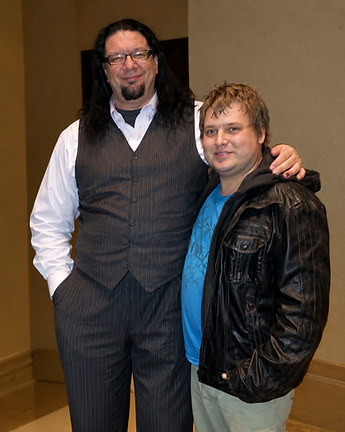
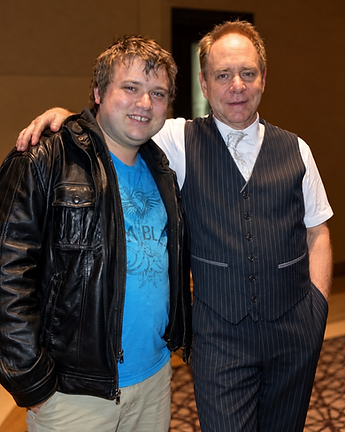
One of the encounters I can document particularly well took place after seeing Penn & Teller perform on January 18, 2013.
After the show, I met both Penn Jillette and Teller outside their theater and had photographs taken with each of them.
At the time, they were simply photographs from a memorable night in Las Vegas. More than a decade later, I look at them somewhat differently. They document a particular moment, place, show, and encounter.
That is exactly the sort of context that can disappear if nobody bothers to preserve it.


Penn & Teller are now represented in the Collection as well.
That creates an interesting relationship between memory and artifact. The photographs document one encounter. A physical object preserves another piece of their history. Neither tells the entire story alone, but together they preserve more than either could separately.
That's something I would not have thought about when the photographs were taken. Back then, I simply wanted to remember the night.
Now, remembering the night is part of what gives the photographs their value.
The Performance Is New Every Night
My experience with Kristen Johnson, known professionally as Lady Houdini, has been different because I have seen her perform at least half a dozen times.
I have also met Kristen and her husband, Kevin Ridgeway, several times. During one of those conversations, I had the opportunity to ask Kevin about an earlier part of their career, when they performed as Living Illusions and toured churches. That conversation stuck with me.
During one of those conversations, Kevin told me about an earlier period in their career when they performed as Living Illusions, touring churches with a gospel-centered illusion show. At that time, Kevin was presented as the primary illusionist, with Kristen performing alongside him. The act that I would later see was very different: Kristen had become Lady Houdini, the featured performer at the center of an escape-driven show, with Kevin supporting the performance.
Hearing about that earlier chapter stuck with me. The performer I knew from the Water Torture Cell had an entire earlier career that an audience seeing Lady Houdini today might never know existed.
In the original Living Illusions format, they were explicitly billed as a two-person duo where Kevin was the primary illusionist, and Kristen was his co-star and "lovely assistant" for the standard magic routines, as is common in traditional magic. Kristen explicitly wanted to subvert this dynamic. In the Lady Houdini Tour, she is the absolute star and the dominant focus. Her husband, Kevin, acts as the facilitator who shackles her, reversing the classic dynamic and showcasing her as a powerful, autonomous lead performer.
Living Illusions was focused heavily on the duo's gospel-centered messaging, using stage magic and illusions as an allegory for Christian faith. The Lady Houdini Tour, by contrast, is a secular, high-energy daredevil stunt show focused strictly on edge-of-your-seat escapology, tension, and entertainment, with a message about breaking stereotypes, women's empowerment, and personal resilience.
This transition shows you that a performer's career is rarely adequately represented by a single famous act, a single poster, or a single photograph. Careers contain earlier shows, changing material, different venues, different audiences, and sometimes entire periods that become surprisingly difficult to reconstruct once enough time has passed.
One particularly well-documented encounter took place at the Delta Fair on September 8, 2021, when my son Taylor and I met Kristen following her performance.
I understood that she had already performed her Water Torture Cell escape more than 3,000 times. Yet for the people standing in front of that stage that evening, the performance was happening for the first time.
I still find that remarkable. For the performer, there may be thousands of repetitions behind a particular act. For someone in the audience, there is only that one moment.

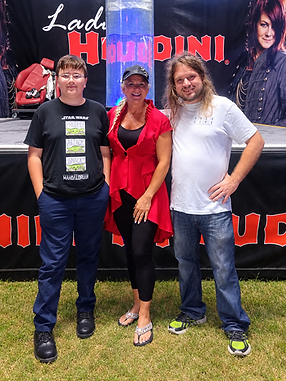
That particular performance now has another connection to the Collection. A performance-used bobby pin from Lady Houdini's Water Torture Cell escape is preserved among its artifacts.
Something that existed as a live experience for only a few minutes now has a physical record.
And because the circumstances surrounding it are known, the object carries more than its physical form with it. It carries a story.
What Remains After the Show
On June 28, 2023, my son Taylor and I saw Brian Ledbetter's Escape Reality in Branson, Missouri.
Afterward, we met Brian and his stage assistant.
Again, the photographs were originally just photographs—something we took because we enjoyed the show and wanted to remember the evening.
Today, I see something else in them.

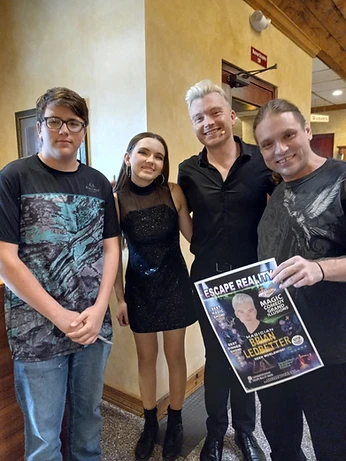

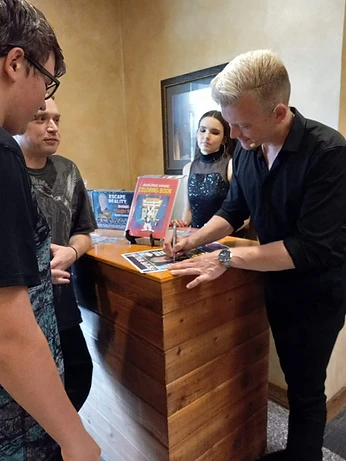
I also have signed material associated with that performance. The object, the date, the photographs, and the memory reinforce one another.
But not every experience leaves behind a photograph.
I've seen Nathan Burton perform in Las Vegas without coming away with a photograph of us together. I've seen regional and touring performers including Braden Foster and David Corn, and pieces associated with those performances survive even though there is no posed photograph documenting every encounter.
The same is true of countless other performances over the years—fairs, circus acts, festivals, community events, and shows whose details I may never be able to reconstruct completely.
Sometimes what remains is a ticket. Sometimes it is a poster. Sometimes a program, autograph, photograph, or piece of advertising survives. Other times, all that remains is the memory of having sat in the audience while a particular version of a show still existed.
All of those things document magic differently.
There are also memories that become more complicated with time.
I saw Jan Rouven during his years performing in Las Vegas. What later became known about his criminal conduct completely changed the context in which I remember that performance. I don't include that experience as a celebration of the performer. But preserving history also means resisting the temptation to quietly remove its uncomfortable parts.
The past does not become more accurate because we prefer some of its stories to others.
If Magic Is A Temporary Experience, Why Save Any of It?
Magic has always had a peculiar preservation problem.
The performance itself disappears the moment it happens.
Afterward, the physical evidence begins disappearing too:
- props are altered, sold, or discarded;
- posters are torn down;
- programs get thrown away;
- tickets disappear into drawers;
- photographs lose their names, dates, and context;
- theaters change names or close;
- performers retire;
- acts evolve;
- and entire versions of shows vanish.
Even enormously successful productions can become surprisingly difficult to reconstruct accurately after enough time has passed.
And then something even more important begins to disappear: the people who remember what all of those things meant.
A ticket can survive for fifty years. But if nobody remembers whose ticket it was, why they went, what they saw, or why that particular night mattered, much of its story has already been lost.
Most of us have encountered this in some form.
An old family photograph survives, but nobody knows who one of the people in it was. A concert ticket turns up in a drawer, but the person who could have told us the story behind it is gone. A box of letters survives, but the circumstances surrounding them have been forgotten.
The object remains, but the context disappears.
That is the part of collecting that increasingly interests me. Preservation is not simply keeping the object. It is trying to keep the story attached to it.
And the smaller parts of magic history may be the most vulnerable of all.
It is easy to understand why someone would preserve material associated with Harry Houdini or David Copperfield. But the history of magic was never created only by its handful of most famous stars.
It was also created at Boy Scout banquets, county fairs, churches, circus performances, art festivals, school auditoriums, Branson theaters, Las Vegas showrooms, convention halls, and community events.
For many people, the magician standing on a temporary stage at a local event was the first magician they ever saw.
That person may have created exactly the same feeling I remember from childhood:
How did they do that?
That history deserves to survive too.
From Souvenir to Artifact
I think that realization explains much of how The Upchurch Collection of Magic developed.
A signed poster can be a souvenir. But identify the performer, production, venue, date, circumstances under which it was signed, and perhaps accompany it with photographs documenting the evening, and suddenly that same poster can tell a much richer story.
A ticket stub may look insignificant sitting by itself. But it can establish exactly when someone attended a particular production—and sometimes which version of a constantly changing show they saw.
A photograph may begin as something taken because you wanted to remember meeting a magician. Years later, it becomes documentation of a moment that cannot be recreated.
And a small object that would mean almost nothing without its history can become something entirely different once you know who used it, where it came from, and how it reached the Collection.
The object hasn't changed.
What has changed is the decision to preserve its context.
That, more than simply accumulating objects, is what increasingly interests me about collecting.
From the Audience to the Archive
The Upchurch Collection of Magic is still developing.
Some objects now enter the Collection through deliberate acquisitions or direct contributions from performers. Others have been with me much longer and are only now being properly cataloged, researched, photographed, and placed into context.
Every so often, I rediscover an old photograph, ticket, poster, program, or memory that reminds me that this project began long before I ever gave it a name.
It began with watching David Copperfield on television, with trying to understand something David Blaine had just done, and with watching Criss Angel transform television magic into spectacle. It started with Grayson Smith performing at a Boy Scout Court of Honor, with magicians at fairs, circuses, art festivals, and community events. And it began in the moments that followed performances at the many Las Vegas theaters and Branson showrooms magicians call home.
The Upchurch Collection doesn't exist because of one performance or one personal meeting; it was born from a desire to remember that familiar moment when something apparently impossible happens, from the feeling you get when part of you immediately wants the answer while another part hopes the mystery survives.
That feeling came first. The collecting came later.
Somewhere along the way, I began to realize that the ticket sitting in a drawer, the photograph taken after a show, the program somebody almost threw away, or the little object handed to an audience member could outlive the performance itself.
But only if someone kept it.
And only if someone remembered why it mattered.
That is what I want The Upchurch Collection of Magic to preserve.
Not simply things.
The people who used them. The performances they came from. The places where those performances happened. The stories people carried home afterward. And, whenever possible, that fleeting feeling of mystery that made someone care about magic in the first place.
For me, the road to the archive began in the audience.
All photos in this article are from the personal collection of Wesley Upchurch.

Follow the Collection
Receive new Stories and collection updates
Receive new Stories, research, acquisitions, and collection updates by email.