
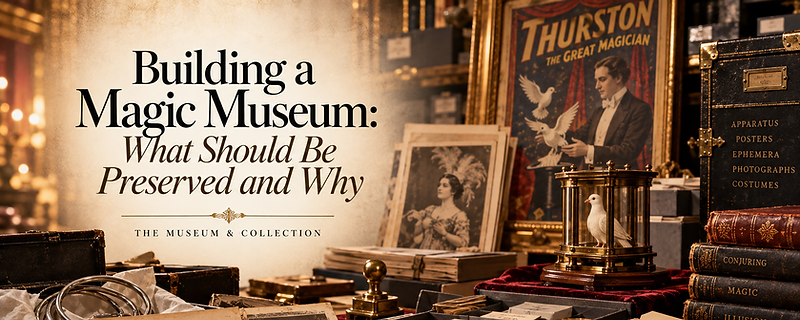
Building a Magic Museum: What Should Be Preserved and Why
A great magic collection cannot be built around famous names and impressive props alone. Posters, photographs, correspondence, tickets, books, performance-used objects, and even seemingly ordinary pieces of ephemera can preserve parts of magic history that would otherwise disappear. The challenge is deciding not simply what to collect, but what stories deserve to survive.
By The Upchurch Collection of Magic
September 28, 2026
What belongs in a magic museum? The obvious answer is magic, but that answer becomes surprisingly complicated the moment you try to define it. A large illusion once used onstage certainly belongs. So might Houdini handcuffs, a magician's costume, or a mechanically ingenious piece of apparatus. Those are the objects most people immediately imagine when they think about preserving the history of magic. But what about a ticket stub, a handwritten letter, a photograph taken after a performance, a program from a show that ran for six months and then disappeared, a cheaply printed handbill from a magician who never became famous, a child's magic set, or a signed poster from a regional performer?
The longer you think about it, the more difficult the question becomes. And that difficulty gets to the heart of what building a serious magic collection actually requires. A museum cannot preserve every object connected to magic, nor should it try. The real task is deciding what an object can tell us once the performance itself is gone.
What Are We Actually Preserving?
Magic presents an unusual problem for the collector because its most important element cannot be placed in a display case. The performance disappears. An illusion may require years of development, engineering, rehearsal, theatrical design, music, lighting, timing, and audience interaction, yet when the curtain closes, most of that experience exists only in the memories of the people who were there. The surviving objects become evidence.
That is why some of the world's important magic collections contain far more than apparatus. The American Museum of Magic in Marshall, Michigan, grew from the private collection assembled by Robert and Elaine Lund and today preserves not only illusions and props but thousands of books, photographs, posters, letters, diaries, periodicals, costumes, scrapbooks, and an enormous body of ephemera. The Harry Ransom Center's Magic Collection offers another example, with holdings that include correspondence, photographs, handbills, playbills, posters, publications, clippings, and descriptions of tricks and illusions. These collections demonstrate an important principle: the history of magic does not survive in props alone. It survives in the material surrounding the performance.
The Obvious Objects — and the Quiet Ones
There will always be objects that immediately command attention. A performance-used escape device has presence. So does an elaborate illusion, a recognizable costume, or an object associated with a famous magician. These objects can provide a direct physical connection to performances that audiences may know only through photographs or film, and they deserve preservation. But they should not crowd everything else out.
A comprehensive magic collection may include:
- Performance-used props and apparatus, documenting the physical and technological side of an act;
- posters, handbills, advertisements, and programs, showing how performers presented themselves and how magic was marketed;
- tickets and passes, establishing dates, venues, productions, and sometimes particular periods in the evolution of a show;
- photographs, especially when the people, date, location, and circumstances remain documented;
- correspondence and manuscripts, preserving relationships among performers, creators, dealers, historians, and collectors;
- books and periodicals, documenting the intellectual history of magic and the circulation of knowledge within the profession;
- costumes and personal objects, revealing the public image and working lives of performers;
- magic sets and instructional material, showing how generations of children and amateurs first encountered the art;
- audio, video, and digital records, increasingly important for documenting contemporary performance;
- ephemera, including flyers, brochures, invitations, promotional cards, notes, receipts, and other material never really intended to last.
Some of these things are glamorous. Most are not. That does not make them historically unimportant. Vienna's Magic Set Museum is a good example of how an apparently ordinary category can become historically significant when preserved systematically. Its collection of thousands of magic sets spanning generations documents not just professional performance but the way magic entered homes and childhoods through commercially produced sets. A magic set someone received for Christmas may never have appeared under theatrical lights, but it may nevertheless explain how another generation became fascinated with magic.
Context Is Part of the Artifact
An object does not carry its entire history inside itself. Imagine two identical signed posters. One arrives without documentation. Nobody knows when it was signed, who obtained it, whether the signature is authentic, or what connection it had to a particular performance. The second comes directly from someone who attended the show. The date and venue are known. The ticket survives. There are photographs from that evening. The person remembers watching the performer sign the poster after the show. Physically, the posters may be nearly identical. Historically, they are not.
The second object carries context. That is why provenance matters so much to a serious collection. The chain of ownership, circumstances of acquisition, dates, locations, photographs, correspondence, certificates, inscriptions, and firsthand recollections surrounding an artifact can be as important as the artifact itself. Sometimes they are more important. A spectacular object with no history attached may leave researchers guessing, while a humble ticket stub with excellent documentation can tell them exactly where someone was, when they were there, and which production they saw.
That is also why documentation should happen now, rather than decades later. Names are forgotten. Dates become uncertain. Venues close. Emails disappear. Websites vanish. People who know the stories die. The longer an object remains undocumented, the greater the chance that part of its history disappears while the physical object survives.
Famous Magicians Are Only Part of Magic History
Any important magic collection will naturally contain famous names. Houdini matters. Kellar matters. Thurston matters. Copperfield matters. The performers who transformed the craft or reached enormous audiences deserve substantial representation. But a museum that preserves only the celebrities of magic would preserve a distorted version of its history.
Magic has never existed only in major theaters. It has existed at fairs, churches, schools, nightclubs, circuses, resorts, conventions, birthday parties, casinos, cruise ships, amusement parks, television studios, community events, and street corners. It has been performed by people who became international stars and by people whose names never appeared outside a single town. That breadth matters. A regional magician's poster may help document a local entertainment culture that otherwise left very little evidence behind. A church magician's program may represent an entire performance circuit largely absent from mainstream histories of magic. A letter between two little-known performers may explain how an illusion, business relationship, or touring act developed.
History has a tendency to remember the winners. Archives can preserve everybody else.
The Problem of Secrets
Magic has another preservation challenge that most museums do not face: some of its artifacts contain secrets. A mechanical apparatus may reveal a method simply by being examined closely. A manuscript may explain an illusion. Correspondence may discuss techniques never intended for a general audience. Books and instructional material may contain knowledge traditionally shared primarily within the magic community.
Preservation therefore does not necessarily mean unrestricted display. A responsible magic collection can recognize a distinction between preserving information and broadcasting information. Some materials may belong in a public exhibition. Others may be appropriate for researchers, historians, or qualified members of the magic community. Still others may need restrictions because of copyright, donor agreements, privacy, or professional considerations. There is nothing contradictory about that. The goal of preservation is not to expose every secret; the goal is to make sure the historical record still exists when legitimate researchers need it.
A museum should be capable of saying both: This should be preserved, and this does not necessarily need to be displayed.
Objects Were Not Made to Last Forever
There is also a practical problem. Magicians generally built props to perform with, not to survive in museum storage for two hundred years. Wood moves. Metal corrodes. Adhesives fail. Paper becomes brittle. Photographs fade. Fabrics deteriorate. Plastics can discolor, crack, or chemically degrade. Improvised repairs made during a performer's working life may become part of the object's history while also creating conservation problems. Ephemera is especially vulnerable because much of it was never expected to survive at all.
That makes basic collection practices important: stable storage, appropriate protective enclosures, environmental control where practical, careful handling, high-quality photography, digitization, and complete catalog records. But conservation should not erase history either. A dent in a performance-used prop may matter. A magician's handwritten correction on a program may matter. An old repair may tell us something about how an apparatus was actually used. The goal is not always to make an object look new. Sometimes wear is evidence.
From Private Collection to Historical Resource
Many important magic collections began because one person cared enough to start saving things. Robert Lund spent decades assembling the material that became the American Museum of Magic. Houdini himself collected books, manuscripts, and ephemera concerning magic and theater, material that continues to inform historical study generations after his death. There is something encouraging about that history because a collection does not have to begin as an institution. It can begin with one object, and then another.
What eventually separates an accumulation from an archive is not simply size or monetary value. It is intention. Are the objects identified? Is their provenance recorded? Are photographs labeled? Are dates preserved while people still remember them? Are related materials kept together? Can someone other than the collector understand why an object matters? Is there a plan for what happens to the collection later? Those questions become increasingly important as a collection grows.
What Should Future Researchers Find?
There is an easy temptation when building a collection to ask, What will impress people? That is not necessarily the most useful question. A better one may be: What will somebody fifty or one hundred years from now wish we had saved?
They will probably want the spectacular objects and the famous names, but they may also want the ordinary things we are most tempted to throw away. They may want the promotional photograph whose photographer and subject were carefully identified, the flyer from the regional magician who performed hundreds of shows but left almost no other paper trail, the correspondence that explains why an act changed, the ticket that establishes when a particular version of a Las Vegas production was running, an early magic set showing what children were learning, photographs of a prop before it was restored, or the collector's notes explaining exactly where an object came from. And they may be enormously frustrated if nobody bothered to preserve any of it.
That is why building The Upchurch Collection of Magic is not simply an exercise in finding increasingly rare objects. The goal is to preserve a record of magic broad enough to include its celebrated performers and its working ones, its spectacular apparatus and its fragile paper, its public performances and the quieter history surrounding them. Some objects will eventually belong behind glass. Some will belong in archival boxes. Some may exist primarily as digital records. Some may be accessible only to researchers. But they share the same purpose: they help answer a question that becomes harder to answer every time another show closes, another performer retires, another collection is dispersed, or another unidentified photograph ends up in a box.
What was magic actually like while it was still alive?
That is what is worth preserving.

Follow the Collection
Receive new Stories and collection updates
Receive new Stories, research, acquisitions, and collection updates by email.