
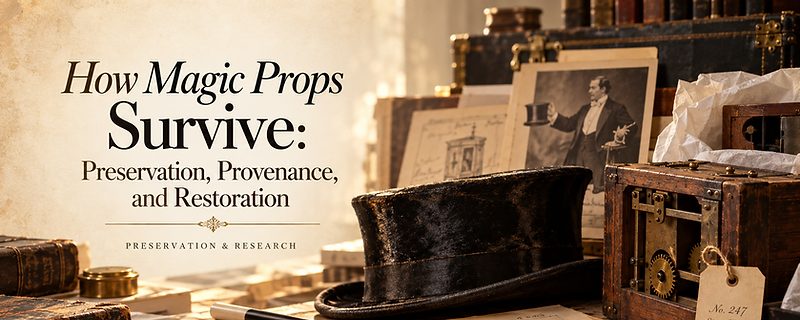
How Magic Props Survive: Preservation, Provenance, and Restoration
Magic props were built to perform, not to spend centuries in museums. Wood warps, metal corrodes, fabric fades, mechanisms seize, and careless restoration can erase the very evidence that makes an object historically important. Preserving magic apparatus therefore requires more than keeping it safe. It requires understanding where it came from, how it was used, what should be repaired, and what should be left alone.
By The Upchurch Collection of Magic
September 28, 2026
A magic prop lives a harder life than most museum objects.
It may be loaded into trucks, carried through backstage corridors, assembled and dismantled hundreds of times, exposed to heat from stage lighting, repaired between performances, repainted when it begins to look tired, modified when an illusion changes, and handled by performers and assistants who are concerned primarily with making the show work that night. A piece of apparatus may survive decades of active performance before anyone begins thinking of it as an artifact.
That history is part of what makes magic props so compelling. They are not merely objects that happened to belong to magicians. They were working tools. A cabinet concealed something. A set of handcuffs created a problem that had to be escaped. A mechanical device moved at exactly the right moment. A costume, table, box, gimmick, or piece of stage furniture existed because a performance depended upon it.
When those objects leave the stage and enter a collection, however, their purpose changes. The question is no longer simply Does it still work? It becomes How do we preserve what this object can tell us?
Props Were Built to Work, Not to Last Forever
The physical construction of magic apparatus makes preservation unusually complicated. Props may combine wood, steel, brass, aluminum, leather, fabric, paint, adhesives, rubber, glass, paper, plastics, electrical components, and mechanical parts within a single object. Each material ages differently, and an environment that is harmless to one component may accelerate deterioration in another.
Wood can expand, shrink, split, and warp as humidity changes. Metal may oxidize or corrode. Leather can dry and crack. Silk and other textiles weaken with age and light exposure. Paint fades or separates from its surface. Rubber hardens. Old adhesives become brittle. Foam deteriorates. Early plastics may discolor, shrink, or chemically break down. Mechanical components can seize after decades without movement, while repeated attempts to operate them may cause more damage than leaving them alone.
This creates a basic conservation principle that is especially important with magic apparatus: an object does not have to function exactly as it once did in order to remain historically valuable. A mechanism may be documented without being repeatedly activated. A fragile trap can remain closed. Internal construction can be photographed, measured, and described without requiring the prop to continue performing its original effect.
That distinction matters because the instinct to "see if it still works" can destroy exactly what a collection is trying to preserve.
The Marks of Performance Matter
Collectors are naturally attracted to beautiful objects. Fresh paint, polished metal, intact fabric, and clean surfaces are visually appealing. But a performance-used prop is not necessarily more historically meaningful because it looks new.
Wear can be evidence.
A scratched edge may show where a cabinet was repeatedly assembled. Replaced screws can reveal field repairs. A performer may have marked a hidden reference point backstage. An assistant's footprint might remain inside an apparatus. Paint may differ from one area to another because a prop was modified between tours. Tape residue, handwritten notes, patched fabric, bent hardware, and imperfect repairs can all tell part of an object's working history.
Those details are sometimes described as the patina of use, but in magic they can be more than cosmetic aging. They can help explain how a prop traveled, how often it was performed, how it was maintained, or how its design evolved.
That means cleaning and restoration have to be approached carefully. Removing grime is not automatically harmless if the "grime" includes old markings or material connected with use. Repainting a cabinet may make it more attractive while permanently eliminating its original finish. Replacing worn hardware may remove evidence of modifications made by the performer.
A prop that looks battered may sometimes tell a better story than one that has been made pristine.
Provenance Can Matter More Than the Prop
A wooden box is a wooden box until someone can explain why it matters.
This is where provenance becomes essential.
Suppose a collector acquires an old illusion cabinet with no documentation. It appears professionally built and may even resemble apparatus associated with a particular era. But no one knows who owned it, who built it, whether it was ever used professionally, when it was modified, or how it reached the present owner.
Now imagine an almost identical cabinet accompanied by photographs showing a specific magician performing with it, letters discussing its construction, shipping labels from a documented tour, a receipt from the original builder, and a clear chain of ownership after the performer's death.
The physical objects might be very similar.
Historically, they are worlds apart.
For a magic collection, provenance may include:
- photographs showing the prop in performance;
- correspondence between a performer, builder, assistant, or previous owner;
- invoices, receipts, shipping records, or contracts;
- inscriptions, labels, serial numbers, builder's marks, or handwritten notes;
- certificates or records from reputable auction houses and dealers;
- photographs taken at the time of acquisition;
- statements from the performer, family, estate, or previous custodian;
- and a documented chain of ownership showing how the object reached the collection.
Not every artifact will have all of these things. Many important objects have incomplete histories. But every surviving piece of documentation should be preserved alongside the object rather than treated as secondary paperwork.
In some cases, the paper may eventually become as valuable to researchers as the prop itself.
The Danger of a Good Story
Magic collecting presents another challenge: the better the story, the more carefully it should be examined.
An object associated with Houdini, Thurston, Kellar, Blackstone, or another major performer may be dramatically more desirable than an unidentified example of the same type. That creates an obvious incentive for stories to become exaggerated as objects pass between owners.
"He owned this" can slowly become "he used this."
"He may have used it" becomes "this was his."
A dealer's recollection becomes provenance. A handwritten note added decades later begins to look authoritative simply because it has aged.
Responsible collecting requires separating what is known, what is documented, what is reported, and what is merely possible.
There is nothing wrong with recording an uncertain tradition surrounding an object. In fact, that information may be useful. But uncertainty should remain visible. "Reportedly used by" is not the same as "documented as used by." "From the estate of" does not automatically prove performance use. A prop manufactured during a magician's lifetime is not necessarily associated with that magician at all.
Sometimes the most professional thing a collection can say is: We do not know.
That is far better than turning an attractive story into false history.
Restoration: How Much Is Too Much?
Restoration creates one of the most difficult decisions in preserving magic apparatus because the object may have several competing identities. It is simultaneously a historical artifact, a piece of mechanical technology, a theatrical object, and sometimes a work of decorative craftsmanship.
A collector may naturally want to make it look the way it appeared on opening night. That may mean replacing fabric, repainting surfaces, rebuilding mechanisms, polishing metal, reproducing decals, or recreating missing parts.
But every intervention changes the artifact.
Replacing a badly worn curtain may make a cabinet visually complete while removing fabric that actually traveled with the performer. Repainting may conceal an earlier color scheme. Replacing a mechanism may make an illusion functional while eliminating evidence of how the original builder solved the problem. Even a well-intentioned repair can make it difficult for future researchers to distinguish original material from modern work.
For that reason, preservation and restoration should not be treated as the same thing.
Preservation attempts to stabilize what survives.
Conservation may involve carefully treating deterioration so that the object remains stable.
Restoration goes further by attempting to return an object toward an earlier appearance or condition.
Sometimes restoration is justified. An unstable structure may require reinforcement. A detached original component may need to be reattached. Missing support may need to be replaced simply to prevent further damage. But whenever possible, intervention should be documented, distinguishable from original material, and limited to what the object actually requires.
The goal should not automatically be make it look new.
The better question is what must be done so that this object and its history survive?
Should a Historic Magic Prop Still Be Performed?
This question becomes especially interesting with magic apparatus because the temptation to demonstrate it is strong.
A vintage automaton that moves is more exciting than one sitting still. A mechanical illusion makes more sense when visitors can see what it does. An escape device may seem incomplete without understanding how it functioned in performance.
But operation causes wear.
A century-old mechanism may have survived precisely because it has not been operated recently. Original leather straps can tear. Springs can fail. wooden components can split. Old electrical systems may be unsafe. Repeated demonstrations may slowly turn an original artifact into a mixture of historic and replacement parts.
That does not mean an object's function should be forgotten. Instead, there are other ways to preserve it. Detailed photography, measurements, diagrams, video documentation made while operation is still safe, oral histories from performers or assistants, and carefully produced replicas can all preserve knowledge of how an apparatus worked without repeatedly risking the original.
In some cases, the best way to demonstrate a historic illusion may be to build a reproduction and leave the original alone.
A museum does not prove that it understands an artifact by wearing it out.
The Secret Inside the Prop
Magic props also contain information that creates an unusual museum problem: their construction may reveal the method of an illusion.
A painting can be examined from every angle without compromising painting as an art form. A magic cabinet may be different. Open the wrong panel, photograph the wrong internal mechanism, or publish the wrong set of dimensions and the museum may reveal something that performers still regard as proprietary knowledge.
Preservation therefore requires documenting information that may not always belong in a public exhibition.
Internal mechanisms should still be photographed and described where appropriate. Modifications should still be recorded. Researchers of theatrical engineering and magic history may eventually need that information. But preserving documentation does not require publishing every detail online.
This is another reason a serious magic collection benefits from separating the public catalog from the archival record.
The public may see the object's history, performer, date, provenance, exterior photographs, and historical significance. Researchers with appropriate access may eventually be able to study additional construction details.
The secret can survive alongside the artifact without becoming the exhibit.
Photograph It Before You Touch It
One of the simplest and most important preservation practices is also one of the easiest to overlook: document an artifact thoroughly before cleaning, repair, restoration, or disassembly.
Photograph the front, back, sides, top, bottom, interior, labels, markings, damage, repairs, hardware, and any unusual construction. Record measurements. Note materials where they can be identified. Photograph the object as it arrived rather than waiting until it has been made presentable.
If something must be removed, document where it came from.
If a component is replaced, retain the original when practical and record exactly what was done.
If the object changes condition, photograph it again.
These records become particularly important decades later when nobody remembers whether a screw was original, whether the paint was already damaged, whether a panel had been replaced, or whether a particular modification occurred before or after the object entered the collection.
The photograph taken before restoration may eventually answer a question the restorer never thought to ask.
Preservation Begins With Knowing the Story
For The Upchurch Collection of Magic, preserving apparatus is therefore about far more than keeping old props in good physical condition.
The object and its history have to survive together.
Who made it?
Who owned it?
Who performed with it?
Where did it appear?
Was it modified?
Are those modifications historic?
Which parts are original?
What documentation accompanied it?
What work has been done since it entered the Collection?
And perhaps most importantly: How much of what we believe about it can actually be proven?
Those questions matter whether the object is an elaborate stage illusion, a set of handcuffs, a wand, a small mechanical prop, or something that appears almost ordinary outside the context of the performance.
A magic prop is the surviving physical evidence of an event that has already disappeared.
The audience is gone. The theater may be gone. The performer may be gone. The music has stopped, the lights are off, and the secret that once existed for only a few moments onstage may now survive inside an object sitting silently in storage.
Preserving that object does not mean erasing its age or forcing it to perform again.
It means keeping enough of the object—and enough of its story—that someone decades from now can still understand what it was, where it came from, and why it mattered.
The illusion was temporary. The evidence does not have to be.
Follow the Collection
Receive new Stories and collection updates
Receive new Stories, research, acquisitions, and collection updates by email.